Mamíferos terrestresLand mammals
Ratón de cola largaLong-tailed colilargo
Oligoryzomys longicaudatus
El ratón silvestre más conocido de Chile, y no por simpático: es el reservorio del hantavirus Andes.The best-known wild mouse in Chile, and not for being endearing: it is the reservoir of the Andes hantavirus.
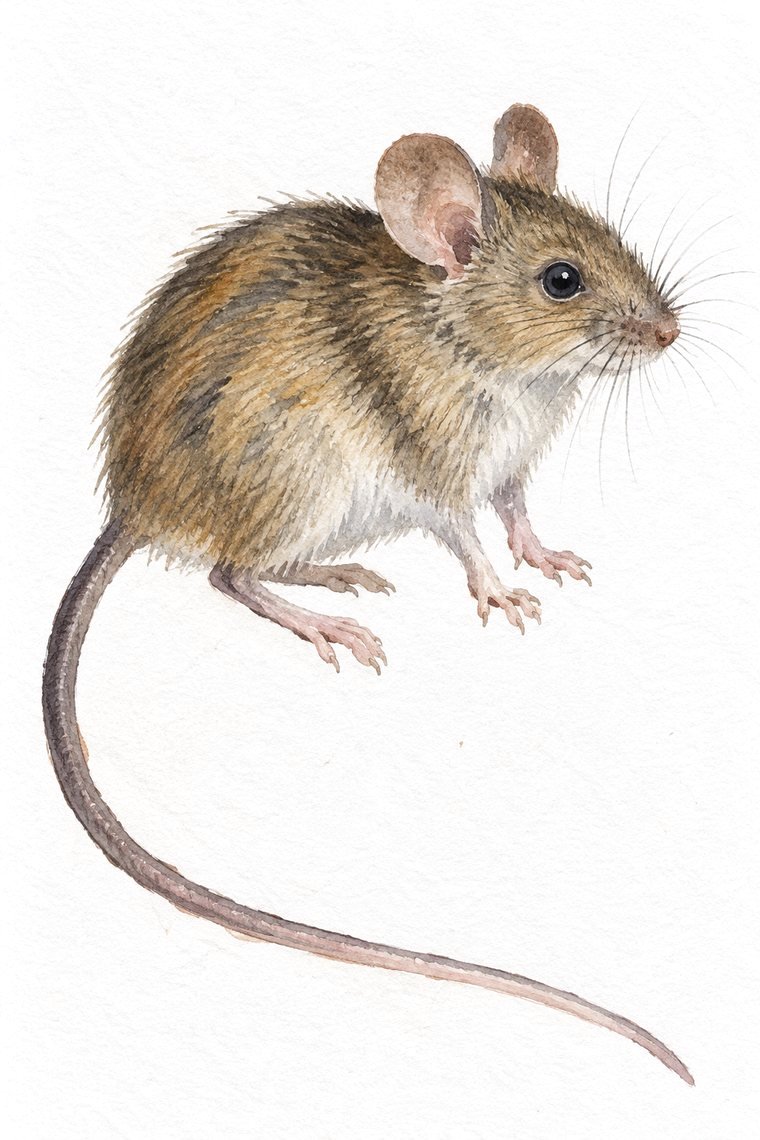
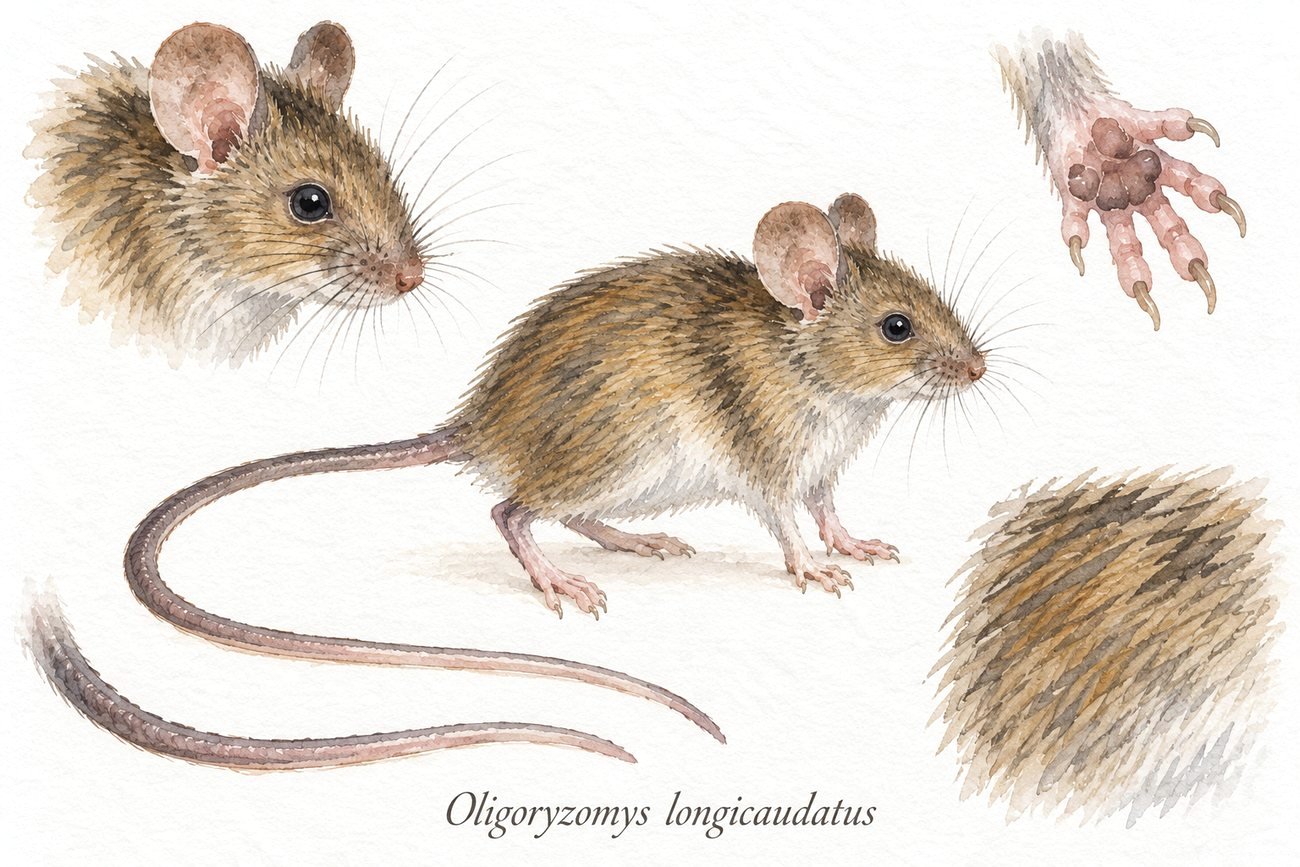
El colilargo es un roedor pequeño de cuerpo esbelto —unos 7 cm de cuerpo— con una cola desnuda que mide casi el doble que el resto del animal. Esa desproporción es lo primero que se ve y basta para separarlo de casi cualquier otro ratón del centro y sur de Chile. El pelaje es pardo amarillento arriba, finamente salpicado de pelos oscuros, y blanco grisáceo abajo.The colilargo is a small rodent with a slender body —some 7 cm of body— and a bare tail almost twice as long as the rest of the animal. That disproportion is the first thing you see and it is enough to separate it from almost any other mouse in central and southern Chile. The coat is yellowish brown above, finely flecked with dark hairs, and grayish white below.
Vive en matorrales, bordes de bosque, quebradas con vegetación densa, cañaverales de quila y coligüe, y también en cercos y potreros cerca de casas rurales. Es un buen trepador: usa la cola larga como balancín para moverse entre ramas y tallos finos, y no es raro encontrarlo a un metro o dos del suelo en la maraña de un matorral. Sale de noche y pasa el día en un nido de fibras vegetales bajo troncos, piedras o raíces.It lives in scrub, forest edges, ravines with dense vegetation, stands of quila and coligüe bamboo, and also in fences and paddocks near country houses. It is a good climber: it uses its long tail as a balance pole to move among branches and thin stems, and it is not unusual to find it a meter or two off the ground in the tangle of a thicket. It comes out at night and spends the day in a nest of plant fibers under trunks, stones or roots.
Su fama viene de la salud pública: es el principal reservorio silvestre del virus Andes, que causa el síndrome cardiopulmonar por hantavirus. El animal no se enferma; elimina el virus en orina, saliva y fecas, y el contagio humano ocurre al respirar polvo contaminado en lugares cerrados y poco ventilados, como bodegas o casas de veraneo recién abiertas. Por eso las recomendaciones sanitarias en Chile insisten en ventilar antes de entrar y en no barrer en seco.Its fame comes from public health: it is the main wild reservoir of the Andes virus, which causes hantavirus cardiopulmonary syndrome. The animal does not fall ill; it sheds the virus in urine, saliva and droppings, and human infection happens by breathing contaminated dust in closed, poorly ventilated places, such as sheds or summer houses just opened up. That is why health advice in Chile insists on airing the place before going in and on not sweeping dry.
Un detalle taxonómico conviene tenerlo presente: en el catálogo aparecen además Oligoryzomys magellanicus y Oligoryzomys yatesi, formas que durante mucho tiempo se trataron como parte de este mismo colilargo y que hoy varios autores separan. En terreno no se distinguen a simple vista; lo que ves en el centro y sur de Chile se informa como colilargo sin más.One taxonomic detail is worth keeping in mind: the catalogue also lists Oligoryzomys magellanicus and Oligoryzomys yatesi, forms long treated as part of this same colilargo and which several authors now separate. In the field they cannot be told apart by eye; what you see in central and southern Chile is reported simply as colilargo.
Datos curiososWorth knowing
La ratada del coligüeThe coligüe ratada
Los bambúes nativos florecen de forma sincronizada cada varias décadas y luego mueren. La lluvia de semillas alimenta un auge del colilargo que multiplica su abundancia local, y meses después la población se desploma cuando el recurso se agota.The native bamboos flower in synchrony every several decades and then die. The rain of seed feeds a boom in colilargos that multiplies their local abundance, and months later the population collapses when the resource runs out.
Contagia sin enfermarseIt infects without falling ill
Como reservorio del virus Andes convive con él sin síntomas. La transmisión a personas es por inhalación de partículas en ambientes cerrados, no por mordedura ni por contacto casual al aire libre.As the reservoir of the Andes virus it lives with it without symptoms. Transmission to people is by inhaling particles in closed spaces, not by a bite or by casual contact in the open air.
La cola le sirve de pértigaThe tail works as a pole
No es prensil, pero su largo extremo funciona como balancín cuando el animal se desplaza por tallos finos, algo excepcional entre los cricétidos chilenos.It is not prehensile, but its extreme length works as a balance pole when the animal moves along thin stems, which is exceptional among Chilean cricetids.
Cómo reconocerlaHow to recognize it
Busca la cola: si es desnuda, más larga que el cuerpo y la cabeza juntos, oscura por arriba y clara por abajo, ya estás en el grupo correcto. Suma orejas grandes y redondeadas muy visibles para el tamaño de la cabeza, hocico afinado con bigotes largos, ojos negros saltones y un dorso pardo amarillento que corta limpio contra un vientre blanquecino. Es un animal liviano, de movimientos rápidos y saltados, que trepa por tallos finos en vez de quedarse pegado al suelo.Look at the tail: if it is bare, longer than body and head together, dark above and pale below, you are already in the right group. Add large, rounded ears, very conspicuous for the size of the head, a tapered muzzle with long whiskers, bulging black eyes and a yellowish brown back that cuts cleanly against a whitish belly. It is a light animal, quick and bounding in its movements, that climbs thin stems instead of staying on the ground.
SeñasField marks
Cola casi el doble del cuerpoA tail almost twice the body
Desnuda, fina y claramente bicolor: oscura arriba, pálida abajo. Ningún otro ratón chileno del mismo tamaño la tiene tan desproporcionada.Bare, fine and clearly two-toned: dark above, pale below. No other Chilean mouse of the same size has one so out of proportion.
Orejas grandes y despegadasLarge, standing ears
Redondeadas, casi sin pelo, tan conspicuas que se notan de perfil aun con poca luz.Rounded, almost hairless, so conspicuous that they show in profile even in poor light.
Vientre blanco de corte netoA cleanly cut white belly
El pardo del dorso no se degrada: cambia a blanco grisáceo en una línea marcada a lo largo del flanco.The brown of the back does not fade out: it changes to grayish white along a marked line down the flank.
Trepador, no solo corredorA climber, not just a runner
Se lo ve subiendo por tallos de quila, zarzas y arbustos, cosa que los ratones del género Abrothrix casi no hacen.It is seen going up quila stems, brambles and shrubs, something the mice of the genus Abrothrix hardly ever do.
Cuándo verlaWhen to see it
Todo el añoAll yearDe nocheBy nightResidenteResident
Activo todo el año, casi siempre después del crepúsculo. En verano y otoño, tras la maduración de semillas, las densidades suben y aumentan los encuentros.Active all year, almost always after dusk. In summer and autumn, once the seed has ripened, densities rise and encounters increase.
Dónde buscarlaWhere to look
Matorral denso y borde de bosque con cobertura al ras del suelo: quilantales y coligüales, zarzamora, orillas de estero con vegetación tupida, pircas y cercos con pastizal alto. También entra a bodegas, leñeras y casas cerradas en el campo, que es justamente donde deja de ser un dato de naturaleza y pasa a ser un tema sanitario.Dense scrub and forest edge with cover right down to the ground: quila and coligüe stands, brambles, stream banks with thick vegetation, dry-stone walls and fences with tall grass. It also comes into sheds, woodpiles and closed-up country houses, which is exactly where it stops being a piece of natural history and becomes a health matter.
No la confundas conDo not confuse it with
Ratón de campo (Oligoryzomys)Ratón de campo (Oligoryzomys)
Es la forma austral del mismo complejo: prácticamente idéntica en pelaje, orejas y cola larga bicolor. En el campo no se separan y lo que manda es la geografía: en el extremo austral se informa como magellanicus y en el centro y sur del país como longicaudatus. Cualquier separación fiable es de laboratorio.This is the southern form of the same complex: practically identical in coat, ears and long two-toned tail. In the field they are not separated and geography rules: in the far south it is reported as magellanicus and in the center and south of the country as longicaudatus. Any reliable separation is laboratory work.
Ratón lanudo común
Mismo tamaño general, mismo ambiente de matorral y bosque húmedo, y a la carrera los dos son bultos pardos. El ratón lanudo tiene la cola claramente más corta que el cuerpo y el pelaje largo y desgreñado; el colilargo tiene pelo corto y liso y la cola casi el doble del cuerpo.The same general size, the same scrub and wet forest, and on the run both are brown shapes. The woolly mouse has a tail clearly shorter than its body and a long, shaggy coat; the colilargo has short, smooth fur and a tail almost twice its body.
Ratón hirto
Comparte el pelaje pardo y los bosques del sur, y suele aparecer en los mismos lugares. El hirto es más robusto, de hocico romo y orejas chicas hundidas en el pelo, con cola corta; el colilargo es delgado, de hocico puntiagudo, orejas grandes salientes y cola larguísima.It shares the brown coat and the southern forests, and often turns up in the same places. The hirto is stockier, with a blunt muzzle and small ears sunk in the fur, and a short tail; the colilargo is slim, with a pointed muzzle, large standing ears and a very long tail.
Más sobre esta especieMore about this species+
Macho y hembraMale and female
Macho y hembra son iguales a la vista: mismo tamaño, mismo color, misma cola. Si estás dudando entre dos individuos, la diferencia no va a ser el sexo.Male and female look alike: same size, same color, same tail. If you are hesitating between two individuals, the difference will not be sex.
VozVoice
Poco vocal. Emite chillidos agudos y muy cortos en peleas o al ser manipulado, además de rechinar de dientes; nada que sirva para detectarlo a distancia.Not very vocal. It gives sharp, very short squeaks in fights or when handled, as well as grinding its teeth; nothing that helps detect it at a distance.
ComportamientoBehaviour
Nocturno y solitario fuera de la época reproductiva. Se mueve en carreras cortas y saltos, y trepa con soltura por tallos y ramas usando la cola como contrapeso. Marca senderos entre la vegetación densa y descansa de día en nidos globosos de fibras bajo troncos caídos, piedras o raíces. Cuando florece y luego muere la quila o el coligüe, la avalancha de semillas dispara explosiones poblacionales locales —las llamadas ratadas— que duran una o dos temporadas y después se desploman.Nocturnal and solitary outside the breeding season. It moves in short dashes and jumps, and climbs easily along stems and branches using its tail as a counterweight. It marks runways through dense vegetation and rests by day in globe-shaped nests of fiber under fallen trunks, stones or roots. When the quila or the coligüe flowers and then dies, the avalanche of seed sets off local population explosions —the so-called ratadas— that last one or two seasons and then collapse.
DietaDiet
Sobre todo semillas, a las que suma frutos carnosos, brotes tiernos, hongos e insectos. En años de semillamiento de bambúes nativos las semillas pasan a dominar casi por completo la dieta.Mainly seeds, to which it adds fleshy fruit, tender shoots, fungi and insects. In years when the native bamboos set seed, seed comes to dominate the diet almost entirely.
ReproducciónBreeding
Cría entre primavera y otoño, con un pico en primavera y verano. Camadas de unas pocas crías, repetidas varias veces en la temporada, nacidas ciegas y desnudas en un nido de fibras. La madurez llega rápido, lo que explica lo veloces que son los repuntes poblacionales.It breeds between spring and autumn, with a peak in spring and summer. Litters of a few young, repeated several times in the season, born blind and naked in a nest of fibers. Maturity comes quickly, which explains how fast the population rebounds are.
Origen del nombreWhere the name comes from
Oligoryzomys significa aproximadamente pequeño ratón del arroz, por el parecido con los ratones arroceros americanos, y longicaudatus es literalmente de cola larga. Los nombres populares apuntan a lo mismo: colilargo en Chile y laucha colilarga en Argentina, además de pericote o lauchita de los espinos.Oligoryzomys means roughly little rice mouse, for the resemblance to the American rice rats, and longicaudatus is literally long-tailed. The common names point to the same thing: colilargo in Chile and laucha colilarga in Argentina, as well as pericote or lauchita de los espinos.
Mitos y erroresMyths and mistakes
Se cree que cualquier ratón que aparece en una casa chilena transmite hantavirus, y no es así: el reservorio del virus Andes es este colilargo, no el ratón doméstico ni la rata de los techos, que son especies introducidas ligadas a la ciudad. También se dice que ataca o persigue a las personas, cuando es un animal huidizo que escapa apenas puede. El riesgo real no está en el animal sino en el polvo de un recinto cerrado sin ventilar.It is believed that any mouse that turns up in a Chilean house transmits hantavirus, and that is not so: the reservoir of the Andes virus is this colilargo, not the house mouse or the roof rat, which are introduced species tied to the city. It is also said that it attacks or chases people, when it is a shy animal that escapes as soon as it can. The real risk lies not in the animal but in the dust of a closed, unaired room.
AmenazasThreats
Como especie no está amenazado y es abundante. La tensión es la inversa: su vínculo con el hantavirus alimenta campañas de eliminación indiscriminada de roedores silvestres, que golpean a especies nativas mucho más frágiles del mismo ambiente. La respuesta sensata es ventilar, sellar y no dejar alimento accesible, no envenenar el matorral.As a species it is not threatened and it is abundant. The tension runs the other way: its link to hantavirus feeds campaigns of indiscriminate killing of wild rodents, which hit far more fragile native species of the same habitat. The sensible answer is to air, seal and leave no food within reach, not to poison the scrub.
Ficha técnicaTechnical sheet+
- Otros nombresOther names
- Laucha colilarga (Argentina), Long-tailed Colilargo (inglés)Laucha colilarga (Argentina), Long-tailed Colilargo (English)
- FamiliaFamily
- Cricetidae · Orden:Order: Rodentia
- OrigenOrigin
- Nativa de Chile y ArgentinaNative to Chile and Argentina
- Estado de conservaciónConservation status
- Argentina: No amenazada · Res. 316/2021 (2021)Argentina: Not threatened · Res. 316/2021 (2021)
- Dónde viveWhere it lives
- Chile · Regiones: La Araucanía, Atacama, Aysén, Biobío, Coquimbo, Los Lagos, Los Ríos, Maule, Metropolitana, Ñuble, O'Higgins y ValparaísoChile · Regions: La Araucanía, Atacama, Aysén, Biobío, Coquimbo, Los Lagos, Los Ríos, Maule, Metropolitana, Ñuble, O'Higgins and Valparaíso
- Dónde viveWhere it lives
- Argentina · Provincias: Chubut, Jujuy, Neuquén, Río Negro, Tierra del Fuego y TucumánArgentina · Provinces: Chubut, Jujuy, Neuquén, Río Negro, Tierra del Fuego and Tucumán
5 fuentes5 sources+
- Estado de conservación en Argentina:Conservation status in Argentina: Resolución MAyDS 316/2021, Anexo I (Boletín Oficial, 24-sep-2021)
- Distribución: GBIF (gbif_cubo_abiertas_2026-10) y GBIF (gbif_occurrences_2026-09-14)Distribution: GBIF (gbif_cubo_abiertas_2026-10) and GBIF (gbif_occurrences_2026-09-14)
- Retrato: ilustración de Explora, generada con IA y revisada por el equipo.Portrait: illustration by Explora, generated with AI and reviewed by the team.
- Lámina: ilustración de Explora, generada con IA y revisada por el equipo.Plate: illustration by Explora, generated with AI and reviewed by the team.
- Texto: Explora, redactado con asistencia de IA.Text: Explora, written with AI assistance.
Otras de mamíferos terrestresMore land mammals