Mamíferos marinosMarine mammals
Delfín australPeale's dolphin
Lagenorhynchus australis
El delfín de los bosques de huiro: en el Estrecho de Magallanes se lo ve nadando entre las algas, a pocos metros de la costa.The dolphin of the kelp forests: in the Strait of Magellan it is seen swimming among the weed, a few meters off the shore.
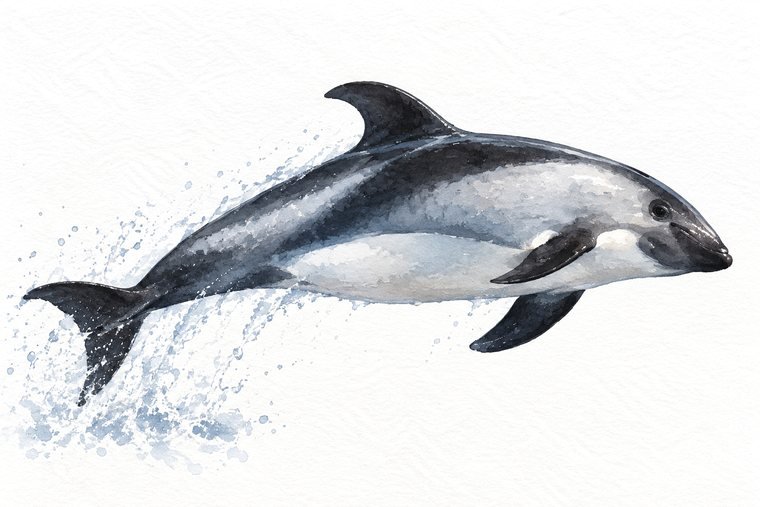
El delfín austral es un delfín pequeño y robusto, de hocico muy corto, que vive sólo en aguas del sur de Sudamérica: desde la zona central de Chile hacia el sur, por los canales y fiordos, hasta Tierra del Fuego, la costa patagónica argentina y las Malvinas. En Chile también lo llaman tunina.Peale's dolphin is a small, stocky dolphin with a very short beak, found only in the waters of southern South America: from central Chile south, through the channels and fjords, to Tierra del Fuego, the Argentine Patagonian coast and the Falkland Islands (Malvinas). In Chile it is also called tunina.
Es una especie muy costera. Prefiere las bahías protegidas, la entrada de canales y fiordos, y sobre todo los bosques de huiro (Macrocystis), donde busca peces y pequeños pulpos y calamares, a veces sacándolos directamente de las frondas. Suele acercarse a las embarcaciones y nadar en la ola de proa.It is a strongly coastal species. It prefers sheltered bays, the mouths of channels and fjords, and above all the kelp forests (Macrocystis), where it looks for fish and small octopus and squid, sometimes taking them straight off the fronds. It often approaches boats and rides the bow wave.
En el Estrecho de Magallanes y cerca de Chiloé se lo ve durante todo el año, con más abundancia en verano. Más al sur, en Tierra del Fuego, se acerca a la costa en verano y se lo ve poco en invierno.In the Strait of Magellan and near Chiloé it is seen all year round, most abundantly in summer. Farther south, in Tierra del Fuego, it comes close to shore in summer and is seldom seen in winter.
Datos curiososWorth knowing
Delfín de dos paísesA dolphin of two countries
Sólo vive en Chile, Argentina y alrededor de las Malvinas; no existe en ninguna otra parte del mundo.It lives only in Chile, Argentina and around the Falkland Islands (Malvinas); it exists nowhere else in the world.
Fue carnadaIt was used as bait
Hasta comienzos de los años setenta se cazó mucho en Magallanes para usarlo como carnada en la pesca de centolla. Esa captura disminuyó después.Until the early nineteen-seventies it was hunted heavily in Magallanes for bait in the king crab fishery. That catch fell away afterward.
Buceos cortosShort dives
Suele hacer series de tres buceos cortos seguidos de uno más largo, y puede aguantar la respiración hasta unos tres minutos.It tends to make runs of three short dives followed by a longer one, and can hold its breath for about three minutes.
Cómo reconocerlaHow to recognize it
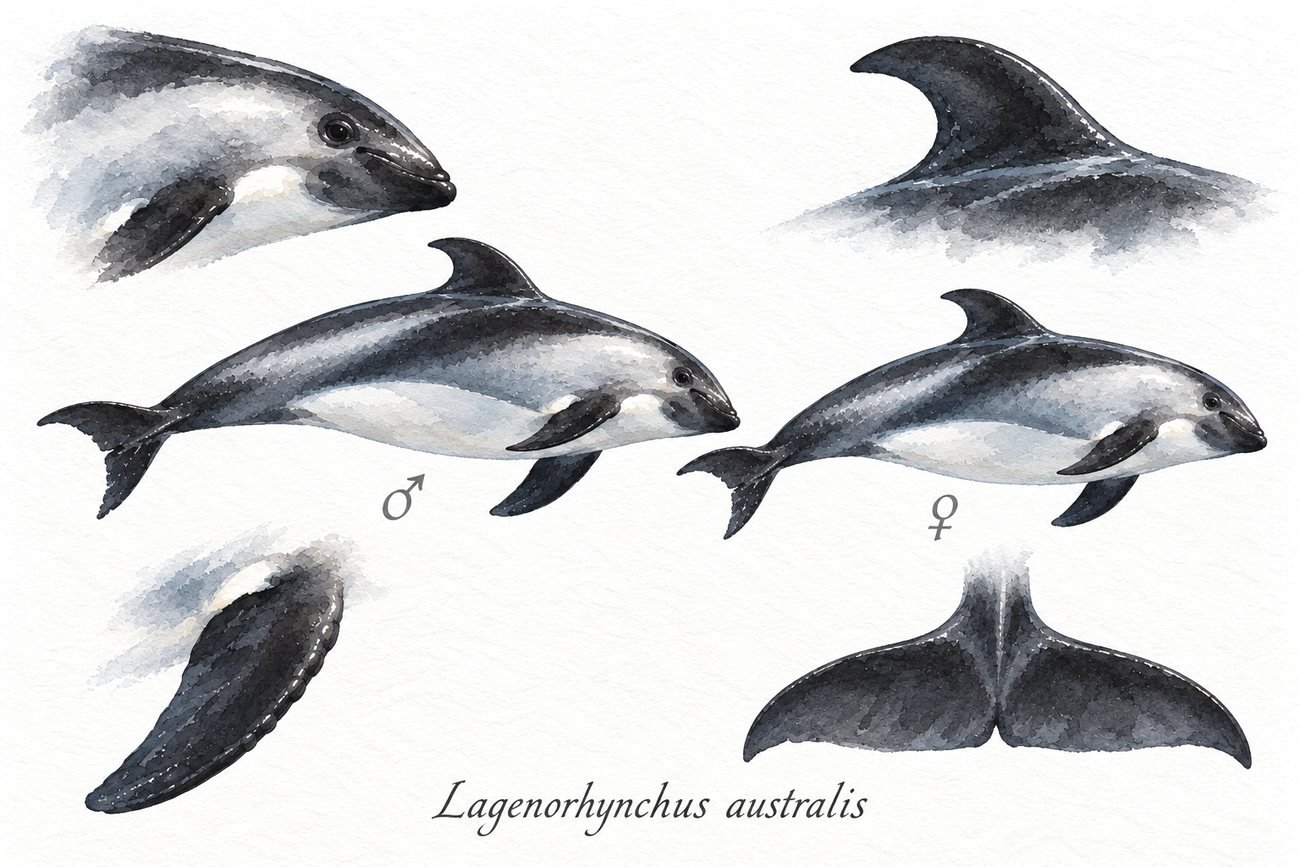
Es un delfín pequeño, de menos de 2,2 m, con el lomo gris oscuro casi negro, una aleta dorsal grande y curvada hacia atrás, y un hocico tan corto que casi no se nota. La clave está en la cara: la punta del hocico, los labios y la garganta son completamente oscuros, y tiene un doble anillo negro alrededor del ojo. En el flanco muestra un parche gris claro grande detrás de la aleta pectoral, con un parche blanco en la axila, y una sola franja clara que sube desde la cola hacia la aleta dorsal.It is a small dolphin, under 2.2 m, with a dark gray, almost black back, a large dorsal fin curved backward, and a beak so short it hardly shows. The key is in the face: the tip of the beak, the lips and the throat are wholly dark, and there is a double black ring around the eye. On the flank it shows a large pale gray patch behind the pectoral fin, with a white patch in the armpit, and a single pale band rising from the tail toward the dorsal fin.
SeñasField marks
Cara y garganta oscurasDark face and throat
Hocico, labios y mentón completamente oscuros. Es el rasgo que lo separa del delfín oscuro, que tiene la cara clara.Beak, lips and chin wholly dark. It is the feature that separates it from the dusky dolphin, which has a pale face.
Parche axilar blancoWhite armpit patch
Una mancha blanca detrás de cada aleta pectoral, dentro de un parche gris claro en el pecho y flanco.A white mark behind each pectoral fin, inside a pale gray patch on the chest and flank.
Una sola franja claraA single pale band
Desde el pedúnculo de la cola sube una franja gris clara que se adelgaza hacia la aleta dorsal.From the tail stock a pale gray band rises and narrows toward the dorsal fin.
Hocico casi inexistenteAlmost no beak
El hocico es muy corto y la frente baja de forma suave; de perfil parece no tener pico.The beak is very short and the forehead slopes down gently; in profile it seems to have no beak at all.
Siempre cerca de las algasAlways near the weed
En la Patagonia se lo ve casi siempre junto o dentro de bosques de huiro, muy cerca de la orilla.In Patagonia it is nearly always seen beside or inside kelp forests, very close to shore.
Cuándo verlaWhen to see it
Todo el añoAll yearDe díaBy dayResidenteResident
En el Estrecho de Magallanes está todo el año, con más avistamientos en verano. Al sur de Tierra del Fuego se acerca a la costa en verano y escasea en invierno.In the Strait of Magellan it is present all year, with more sightings in summer. South of Tierra del Fuego it comes close to shore in summer and becomes scarce in winter.
Dónde buscarlaWhere to look
Bordes de bosques de huiro en bahías tranquilas, entrada de canales y fiordos, y la costa del Estrecho cerca de Punta Arenas. También desde transbordadores y botes en el Estrecho y el canal Beagle, donde se acerca a la proa.The edges of kelp forests in calm bays, the mouths of channels and fjords, and the shore of the Strait near Punta Arenas. Also from ferries and boats in the Strait and the Beagle Channel, where it comes to the bow.
No la confundas conDo not confuse it with
Delfín oscuro
Mismo tamaño y forma, aleta dorsal parecida y patrón gris y blanco en los flancos. El delfín oscuro tiene la cara y la garganta claras y dos franjas claras que se adelantan por el flanco; el austral tiene el mentón oscuro y una sola franja. Además, el oscuro suele estar más mar adentro.The same size and shape, a similar dorsal fin and the same gray and white flank pattern. The dusky dolphin has a pale face and throat and two pale bands that run forward along the flank; Peale's has a dark chin and a single band. The dusky also tends to stay farther offshore.
Tonina overaCommerson's dolphin
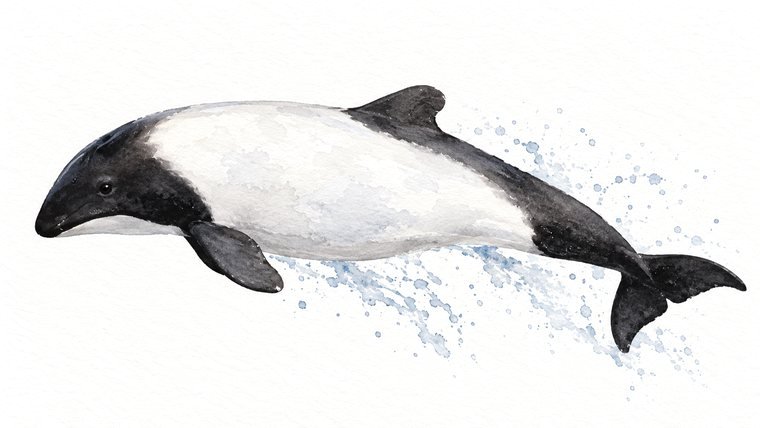
Delfín pequeño y costero de la Patagonia que a veces nada junto al austral. La tonina overa es blanca y negra con contraste muy marcado, como una orca en miniatura, y su aleta dorsal es redondeada, no curvada en punta.A small coastal dolphin of Patagonia that sometimes swims alongside Peale's. Commerson's dolphin is white and black in very sharp contrast, like a killer whale in miniature, and its dorsal fin is rounded, not curved to a point.
Ver su fichaSee its sheetDelfín cruzado
Mismo género, lomo oscuro y flancos con blanco. El cruzado tiene un dibujo blanco en forma de reloj de arena en cada flanco y vive en mar abierto, lejos de la costa; casi nunca entra a canales.Same genus, dark back and white on the flanks. The hourglass dolphin carries a white hourglass figure on each flank and lives in the open sea, far from the coast; it almost never enters the channels.
Más sobre esta especieMore about this species+
Macho y hembraMale and female
Macho y hembra tienen el mismo diseño de colores; los machos pueden ser algo más grandes, pero en el agua no se distinguen.Male and female have the same color pattern; males may be somewhat larger, but in the water they cannot be told apart.
JuvenilJuvenile
Los juveniles son más claros que los adultos y sus manchas están menos definidas, lo que puede hacerlos parecer otra especie.Young animals are paler than adults and their markings are less defined, which can make them look like another species.
ComportamientoBehaviour
Anda en grupos pequeños, por lo general de 2 a 20 animales. A menudo nada lento entre las algas, pero también es acrobático: salta, cae de costado haciendo un fuerte chapoteo y acompaña a las embarcaciones nadando en la ola de proa. A veces se lo ve junto a la tonina overa.It travels in small groups, usually of 2 to 20 animals. It often swims slowly among the weed, but it is also acrobatic: it leaps, lands on its side with a loud splash and accompanies boats by riding the bow wave. It is sometimes seen alongside Commerson's dolphin.
DietaDiet
Come peces de fondo, pulpos y calamares pequeños, y camarones. Gran parte de su caza ocurre en los bosques de huiro.It eats bottom fish, small octopus and squid, and shrimp. Much of its hunting happens in the kelp forests.
ReproducciónBreeding
Se sabe poco. Se han visto crías entre octubre y abril, y las madres con crías se quedan en sectores costeros protegidos.Little is known. Calves have been seen between October and April, and mothers with calves stay in sheltered coastal stretches.
Origen del nombreWhere the name comes from
Australis significa 'del sur' en latín. En inglés se lo llama Peale's dolphin por Titian Peale, el naturalista que lo describió en 1848. En Chile también se le dice tunina, llampa o cahuel.Australis means 'of the south' in Latin. In English it is called Peale's dolphin after Titian Peale, the naturalist who described it in 1848. In Chile it is also called tunina, llampa or cahuel.
AmenazasThreats
Su apego a la costa y a los bosques de huiro lo expone a la pérdida de ese hábitat, al crecimiento de la acuicultura en los canales y a enredos en redes. La caza para carnada de centolla, que fue su mayor amenaza en Magallanes, disminuyó desde los años setenta.Its attachment to the coast and to the kelp forests exposes it to the loss of that habitat, to the growth of aquaculture in the channels and to entanglement in nets. Hunting for king crab bait, which was its greatest threat in Magallanes, declined from the nineteen-seventies on.
Ficha técnicaTechnical sheet+
- Otros nombresOther names
- Peale's Dolphin (inglés)Peale's Dolphin (English)
- FamiliaFamily
- Delphinidae · Orden:Order: Cetacea
- OrigenOrigin
- Nativa de Chile y ArgentinaNative to Chile and Argentina
- Estado de conservaciónConservation status
- Chile: Preocupación menor · RCE (2017)Chile: Least concern · RCE (2017)
- Estado de conservaciónConservation status
- Argentina: No amenazada · Res. 316/2021 (2021)Argentina: Not threatened · Res. 316/2021 (2021)
- Dónde viveWhere it lives
- Chile · Regiones: La Araucanía, Aysén, Biobío, Los Lagos, Los Ríos, Magallanes, Maule, Ñuble, O'Higgins y ValparaísoChile · Regions: La Araucanía, Aysén, Biobío, Los Lagos, Los Ríos, Magallanes, Maule, Ñuble, O'Higgins and Valparaíso
9 fuentes9 sources+
- Ficha de antecedentes Lagenorhynchus australis, 13° proceso RCE (MMA Chile)
- Lagenorhynchus australis (Plazi, tratamiento HMW)
- Lagenorhynchus australis (SeaLifeBase)
- Estado de conservación en Chile:Conservation status in Chile: DS 29/2011 MMA (Reglamento); nómina consolidada del 20.º proceso, 8-jun-2026
- Estado de conservación en Argentina:Conservation status in Argentina: Resolución MAyDS 316/2021, Anexo I (Boletín Oficial, 24-sep-2021)
- Distribución: RCE (Ministerio del Medio Ambiente de Chile) (rce_mma_2026-03)Distribution: RCE (Ministerio del Medio Ambiente de Chile) (rce_mma_2026-03)
- Retrato: ilustración de Explora, generada con IA y revisada por el equipo.Portrait: illustration by Explora, generated with AI and reviewed by the team.
- Lámina: ilustración de Explora, generada con IA y revisada por el equipo.Plate: illustration by Explora, generated with AI and reviewed by the team.
- Texto: Explora, redactado con asistencia de IA.Text: Explora, written with AI assistance.
Otras de mamíferos marinosMore marine mammals