Mamíferos marinosMarine mammals
Foca leopardoLeopard seal
Hydrurga leptonyx
Es la única foca que caza rutinariamente a otras focas, y desde hace pocos años se sabe que también pare sus crías en los fiordos de Tierra del Fuego.It is the only seal that routinely hunts other seals, and only in recent years has it been known to give birth in the fjords of Tierra del Fuego as well.
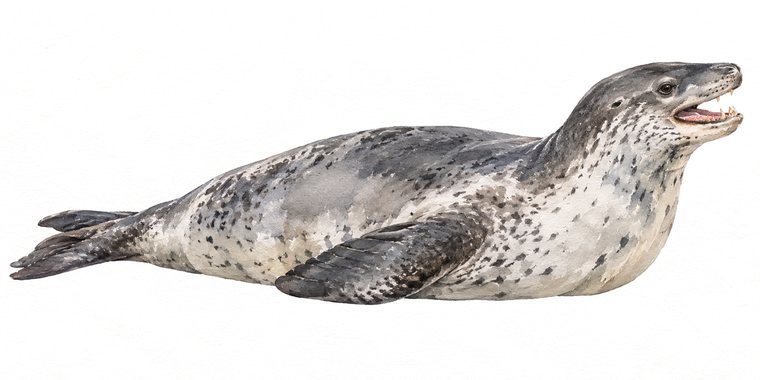
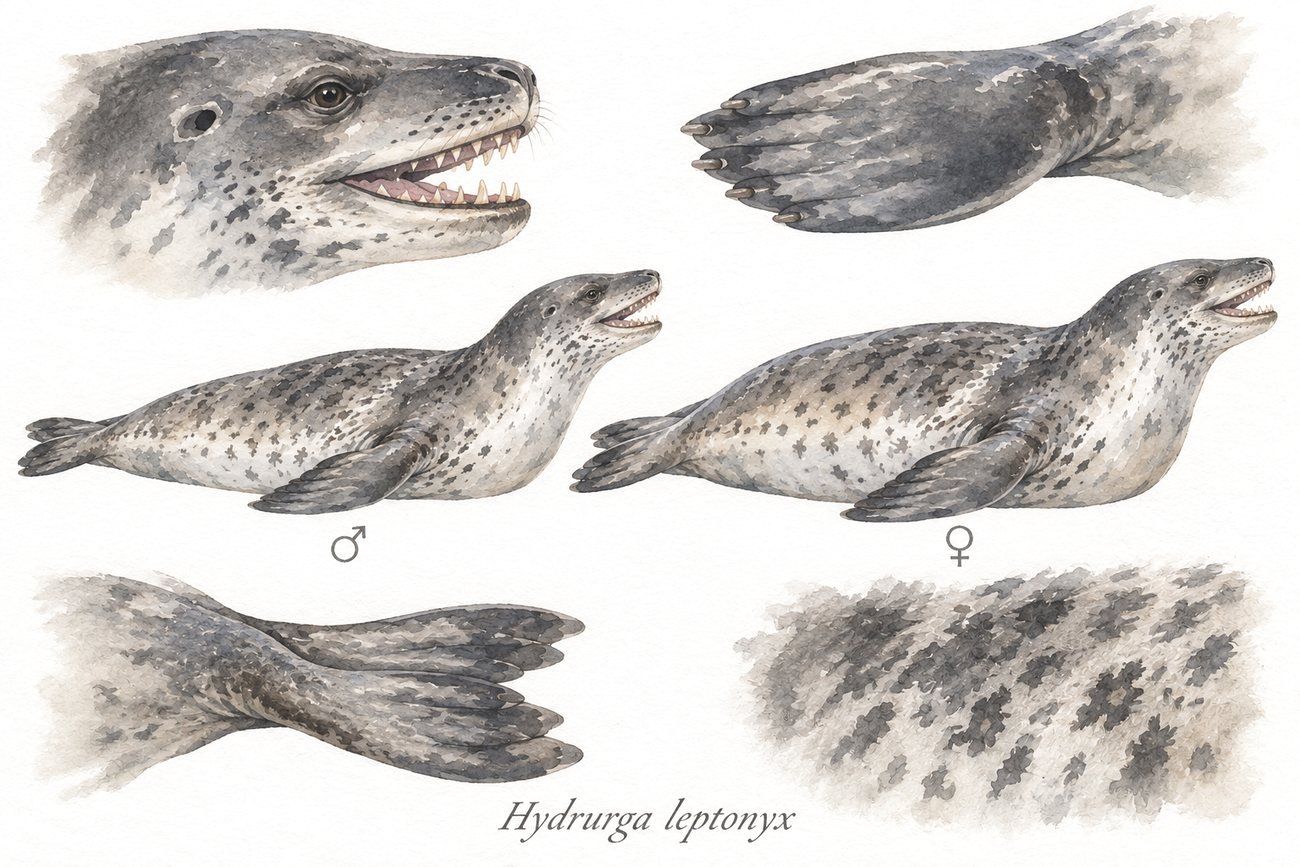
La foca leopardo tiene una cabeza que no parece de foca. Es grande, alargada y de aspecto reptiliano, con una boca enorme cuya comisura curvada hacia arriba le da esa expresión de sonrisa que aparece en todas las fotos. El cuerpo es largo y musculoso, sin la panza redonda de otros fócidos, y las aletas pectorales son desproporcionadamente largas, lo que le permite girar en el agua con una agilidad que sorprende para su tamaño.The leopard seal has a head that does not look like a seal's. It is large, elongated and reptilian, with an enormous mouth whose upturned corner gives it the smile that appears in every photograph. The body is long and muscular, without the round belly of other true seals, and the pectoral flippers are disproportionately long, which lets it turn in the water with an agility surprising for its size.
Es un animal solitario y territorial. Caza pingüinos en los bordes del hielo, come crías de otras focas y persigue peces y calamares, pero también filtra krill en cantidades enormes con sus muelas lobuladas, que encajan entre sí como un colador. Esa doble vida, depredador de sangre caliente y filtrador de crustáceos, es más extraña que la reputación de fiera con la que se la suele presentar.It is a solitary, territorial animal. It hunts penguins at the ice edge, eats the pups of other seals and chases fish and squid, but it also filters krill in enormous quantities with its lobed molars, which mesh together like a sieve. That double life, warm-blooded predator and crustacean filterer, is stranger than the reputation for ferocity it is usually introduced with.
En Chile no es una rareza antártica de paso. En los fiordos australes y en torno a Tierra del Fuego se la ve durante todo el año, y allí se han documentado hembras con cría, los primeros nacimientos registrados en Sudamérica. Más al norte la historia cambia: los animales que llegan a las costas del centro y norte del país son casi siempre juveniles, sobre todo en invierno, y suelen aparecer flacos y varados en la playa.In Chile it is not an Antarctic rarity passing through. In the southern fjords and around Tierra del Fuego it is seen all year round, and females with pups have been documented there, the first births recorded in South America. Farther north the story changes: the animals that reach the coasts of central and northern Chile are almost always juveniles, above all in winter, and they usually turn up thin and stranded on the beach.
Datos curiososWorth knowing
Filtra krill como una ballena chicaIt filters krill like a small whale
Sus molares tienen tres lóbulos que encajan con los del maxilar opuesto y forman un colador. Traga agua con krill y la expulsa por los costados reteniendo los crustáceos, exactamente lo mismo que hace la foca cangrejera.Its molars have three lobes that mesh with those of the opposing jaw and form a sieve. It takes in water with krill and expels it through the sides, keeping the crustaceans, exactly as the crabeater seal does.
Canta colgada en el aguaIt sings hanging in the water
En primavera los machos pasan muchas horas al día emitiendo secuencias de trinos bajo el agua, suspendidos cabeza abajo. Cada individuo tiene un repertorio propio y los patrones se repiten con una regularidad casi musical.In spring males spend many hours a day giving sequences of trills underwater, suspended head down. Each individual has its own repertoire and the patterns repeat with an almost musical regularity.
Crías en Chile, no solo en la AntárticaPups in Chile, not only in Antarctica
Durante décadas se la consideró una visitante antártica ocasional en Sudamérica. Los avistamientos de hembras con cría en el seno Almirantazgo cambiaron esa idea: al menos algunas nacen en fiordos chilenos.For decades it was taken to be an occasional Antarctic visitor in South America. Sightings of females with pups in Admiralty Sound changed that: at least some are born in Chilean fjords.
Cómo reconocerlaHow to recognize it
Es una foca grande, de más de dos metros y medio, gris plateada arriba y más clara abajo, salpicada de manchas oscuras irregulares en la garganta, el pecho y los costados. Lo que la delata de inmediato es la cabeza: enorme, alargada, con el hocico prominente y la línea de la boca curvada hacia arriba, muy distinta de la cabeza chica y redonda del resto de las focas. Suma el cuello largo y flexible, que puede levantar y girar como una serpiente, y las aletas delanteras largas y anchas.It is a large seal, over two and a half meters, silver gray above and paler below, scattered with irregular dark spots on the throat, chest and sides. What gives it away at once is the head: huge, elongated, with a prominent muzzle and the line of the mouth curved upward, very unlike the small round head of other seals. Add the long flexible neck, which it can raise and turn like a snake, and the long, broad front flippers.
SeñasField marks
Cabeza grande y reptilianaLarge reptilian head
La cabeza es maciza, alargada y desproporcionada respecto del cuerpo, con el hocico marcado. Vista de perfil recuerda más a un reptil que a una foca.The head is massive, elongated and out of proportion to the body, with a marked muzzle. Seen in profile it recalls a reptile more than a seal.
La sonrisaThe smile
La comisura de la boca se curva hacia arriba y la abertura bucal es enorme, mucho mayor que en cualquier otra foca austral. Es visible incluso en animales echados y quietos.The corner of the mouth curves upward and the gape is enormous, far larger than in any other southern seal. It shows even in animals lying still.
Manchas tipo leopardoLeopard-like spots
Sobre el gris plateado del cuerpo hay manchas oscuras irregulares dispersas, concentradas en la garganta, el pecho y los flancos. El patrón no es de puntos regulares sino de borrones desiguales.Over the silver gray of the body there are scattered irregular dark spots, concentrated on the throat, chest and flanks. The pattern is not of regular dots but of uneven blotches.
Aletas pectorales muy largasVery long pectoral flippers
Las aletas delanteras son notablemente largas y anchas para una foca, y las usa activamente para maniobrar. Otras focas australes las tienen cortas y las mantienen pegadas al cuerpo.The front flippers are notably long and broad for a seal, and it uses them actively to maneuver. Other southern seals have short ones and keep them against the body.
Siempre solaAlways alone
Fuera de las hembras con cría, se la ve invariablemente en solitario, echada en un témpano o en la playa. Las focas cangrejeras y de Weddell tienden a agruparse.Apart from females with pups, it is invariably seen on its own, lying on an ice floe or on the beach. Crabeater and Weddell seals tend to gather.
Cuándo verlaWhen to see it
Todo el añoAll yearDe díaBy dayResidenteResident
En los fiordos australes y en torno a Tierra del Fuego hay animales todo el año. En el centro y norte del país los avistamientos son de juveniles dispersos y se concentran en los meses de invierno.In the southern fjords and around Tierra del Fuego there are animals all year. In central and northern Chile the sightings are of scattered juveniles and are concentrated in the winter months.
Dónde buscarlaWhere to look
En el sur, témpanos desprendidos de glaciares y playas de canto rodado dentro de fiordos y senos, sobre todo donde hay colonias de pingüinos o lobos cerca. Más al norte, playas abiertas donde aparecen animales varados; si encuentras uno, mantén distancia y avisa a la autoridad marítima en vez de acercarte.In the south, floes calved from glaciers and cobble beaches inside fjords and sounds, above all where there are penguin or sea lion colonies nearby. Farther north, open beaches where stranded animals appear; if you find one, keep your distance and notify the maritime authority instead of approaching.
No la confundas conDo not confuse it with
Foca de Weddell
Las dos son focas grandes, moteadas y de aguas australes, y comparten los mismos hielos. La foca de Weddell tiene la cabeza chica y redonda con hocico corto, que se ve claramente pequeña respecto del cuerpo rechoncho; la leopardo tiene la cabeza grande y alargada y el cuerpo delgado y musculoso.Both are large, mottled seals of southern waters, and they share the same ice. The Weddell seal has a small round head with a short muzzle, clearly small against its chunky body; the leopard seal has a large elongated head and a slim, muscular body.
Foca cangrejera
Ambas son esbeltas, de hocico alargado y viven en el hielo. La cangrejera es de un pardo plateado casi uniforme, con cicatrices lineales pero sin manchas oscuras, y se ve en grupos; la leopardo lleva manchas oscuras evidentes en garganta y flancos y es solitaria.Both are slender, long-muzzled and live on the ice. The crabeater is an almost uniform silvery brown, with linear scars but no dark spots, and is seen in groups; the leopard seal carries obvious dark spots on throat and flanks and is solitary.
Elefante marino
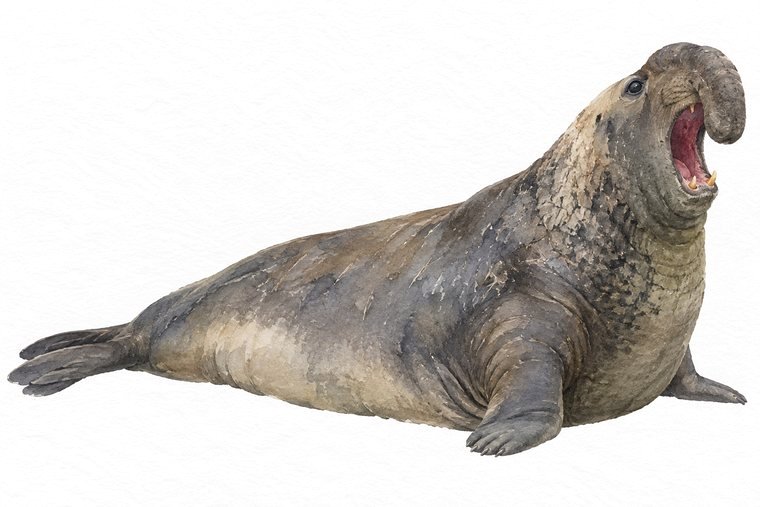
Las dos son focas muy grandes que descansan en playas australes. El elefante marino es mucho más voluminoso y macizo, de color pardo uniforme sin manchas, y se agrupa en playas de arena; el macho adulto tiene una probóscide inconfundible.Both are very large seals that rest on southern beaches. The elephant seal is far bulkier and heavier, a uniform brown without spots, and gathers on sandy beaches; the adult male has an unmistakable proboscis.
Más sobre esta especieMore about this species+
Macho y hembraMale and female
Las hembras son algo más grandes y pesadas que los machos, pero el color y el patrón de manchas son iguales en ambos sexos, así que en terreno no vas a poder sexar al animal.Females are somewhat larger and heavier than males, but the color and the pattern of spots are the same in both sexes, so in the field you will not be able to sex the animal.
MachoMale
Algo menor y más liviano que la hembra. Mismo patrón de manchas.Somewhat smaller and lighter than the female. The same pattern of spots.
HembraFemale
Ligeramente mayor en largo y peso. Mismo patrón de manchas.Slightly greater in length and weight. The same pattern of spots.
JuvenilJuvenile
Los juveniles son la mayoría de los animales que aparecen varados en el centro y norte de Chile. Tienen el patrón de manchas más difuso y suelen verse delgados, con la cabeza proporcionalmente todavía más grande.Juveniles are most of the animals that turn up stranded in central and northern Chile. Their spotting is more diffuse and they usually look thin, with the head proportionally larger still.
Según la épocaBy season
No hay plumaje ni pelaje estacional distinto; la muda ocurre en verano y deja el pelaje más opaco por unas semanas.There is no distinct seasonal coat; the molt happens in summer and leaves the fur duller for a few weeks.
VozVoice
Bajo el agua produce una serie muy estructurada de trinos, gorjeos y pulsos graves que se transmiten a kilómetros. En superficie es prácticamente muda, salvo gruñidos cortos de advertencia.Underwater it produces a highly structured series of trills, warbles and low pulses that carry for kilometers. At the surface it is practically silent, apart from short warning growls.
ComportamientoBehaviour
Solitaria y territorial. Pasa horas echada sobre témpanos o playas y se lanza al agua al menor acercamiento. Bajo el agua es curiosa y puede aproximarse a embarcaciones y buzos, con un lenguaje corporal de boca abierta y cabeza levantada que conviene leer como advertencia. Durante la temporada reproductiva los machos vocalizan bajo el agua durante horas seguidas, colgados cabeza abajo en la columna de agua.Solitary and territorial. It spends hours lying on floes or beaches and takes to the water at the slightest approach. Underwater it is curious and may come up to boats and divers, with a body language of open mouth and raised head that is best read as a warning. During the breeding season males vocalize underwater for hours on end, hanging head down in the water column.
DietaDiet
Muy amplia y flexible. Pingüinos, crías de otras focas, peces, calamares y krill, este último en proporciones altísimas en ciertas épocas. Sus muelas lobuladas encajan entre sí y le permiten filtrar krill del agua, igual que hace la foca cangrejera.Very broad and flexible. Penguins, the pups of other seals, fish, squid and krill, the last in very high proportions at certain times of year. Its lobed molars mesh together and let it filter krill from the water, just as the crabeater seal does.
ReproducciónBreeding
Las hembras paren una sola cría sobre el hielo marino, en primavera y comienzos del verano. Es una especie de la que se sabe poco porque la cría ocurre sobre hielo disperso y de difícil acceso. Los nacimientos documentados en los fiordos de Tierra del Fuego fueron los primeros registrados en Sudamérica.Females bear a single pup on the sea ice, in spring and early summer. Little is known about the species because breeding happens on scattered, hard-to-reach ice. The births documented in the fjords of Tierra del Fuego were the first recorded in South America.
Origen del nombreWhere the name comes from
El nombre común alude al patrón de manchas y al estilo de caza. El género Hydrurga significa trabajadora del agua, y el epíteto leptonyx, uña delgada, describe las garras finas de sus aletas.The common name alludes to the pattern of spots and to the hunting style. The genus Hydrurga means water worker, and the epithet leptonyx, slender claw, describes the fine claws on its flippers.
Mitos y erroresMyths and mistakes
La fama de fiera sanguinaria que solo come pingüinos es exagerada: el krill puede representar una parte enorme de su dieta. En sentido inverso, tampoco es inofensiva, y conviene no acercarse a un animal varado. Otro error de catálogo frecuente es listarla para regiones interiores del país: es estrictamente marina y costera.Its reputation as a bloodthirsty beast that eats only penguins is overstated: krill can make up an enormous share of its diet. In the other direction, neither is it harmless, and it is best not to approach a stranded animal. Another common cataloguing error is listing it for inland regions of the country: it is strictly marine and coastal.
AmenazasThreats
Globalmente está en preocupación menor y no tiene depredadores más allá de la orca. Lo que la afecta es indirecto y de fondo: la reducción del hielo marino, que es su plataforma de cría y de caza, y las variaciones en la abundancia de krill por efecto de la pesquería y del cambio en las temperaturas del océano austral.Globally it is of least concern and it has no predator beyond the killer whale. What affects it is indirect and deep-seated: the reduction of sea ice, which is its platform for breeding and hunting, and shifts in the abundance of krill through fishing and through changing temperatures in the Southern Ocean.
Ficha técnicaTechnical sheet+
- Otros nombresOther names
- Leopard Seal (inglés)Leopard Seal (English)
- FamiliaFamily
- Phocidae · Orden:Order: Carnivora
- OrigenOrigin
- Nativa de Chile y ArgentinaNative to Chile and Argentina
- Estado de conservaciónConservation status
- Chile: Preocupación menor · RCE (2017)Chile: Least concern · RCE (2017)
- Estado de conservaciónConservation status
- Argentina: No amenazada · Res. 316/2021 (2021)Argentina: Not threatened · Res. 316/2021 (2021)
- Dónde viveWhere it lives
- Chile · Regiones: Aysén, Biobío, Coquimbo, Magallanes y ValparaísoChile · Regions: Aysén, Biobío, Coquimbo, Magallanes and Valparaíso
6 fuentes6 sources+
- Estado de conservación en Chile:Conservation status in Chile: DS 29/2011 MMA (Reglamento); nómina consolidada del 20.º proceso, 8-jun-2026
- Estado de conservación en Argentina:Conservation status in Argentina: Resolución MAyDS 316/2021, Anexo I (Boletín Oficial, 24-sep-2021)
- Distribución: RCE (Ministerio del Medio Ambiente de Chile) (rce_mma_2026-03)Distribution: RCE (Ministerio del Medio Ambiente de Chile) (rce_mma_2026-03)
- Retrato: ilustración de Explora, generada con IA y revisada por el equipo.Portrait: illustration by Explora, generated with AI and reviewed by the team.
- Lámina: ilustración de Explora, generada con IA y revisada por el equipo.Plate: illustration by Explora, generated with AI and reviewed by the team.
- Texto: Explora, redactado con asistencia de IA.Text: Explora, written with AI assistance.
Otras de mamíferos marinosMore marine mammals