Mamíferos terrestresLand mammals
Tuco tuco de MagallanesMagellanic tuco-tuco
Ctenomys magellanicus
Pasa la vida bajo tierra y sale poco, pero en la colonia de Bahía Inútil se asoma entre sus montículos.It spends its life underground and rarely comes out, but at the Useless Bay colony it shows itself among its mounds.
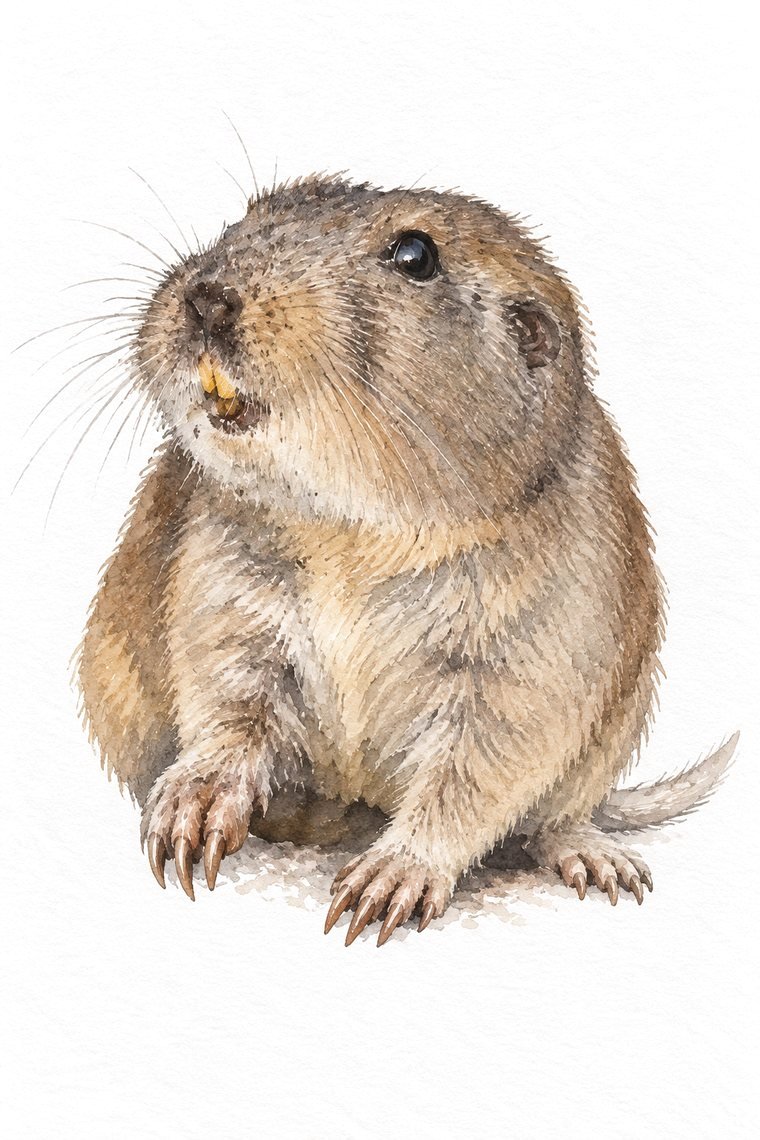
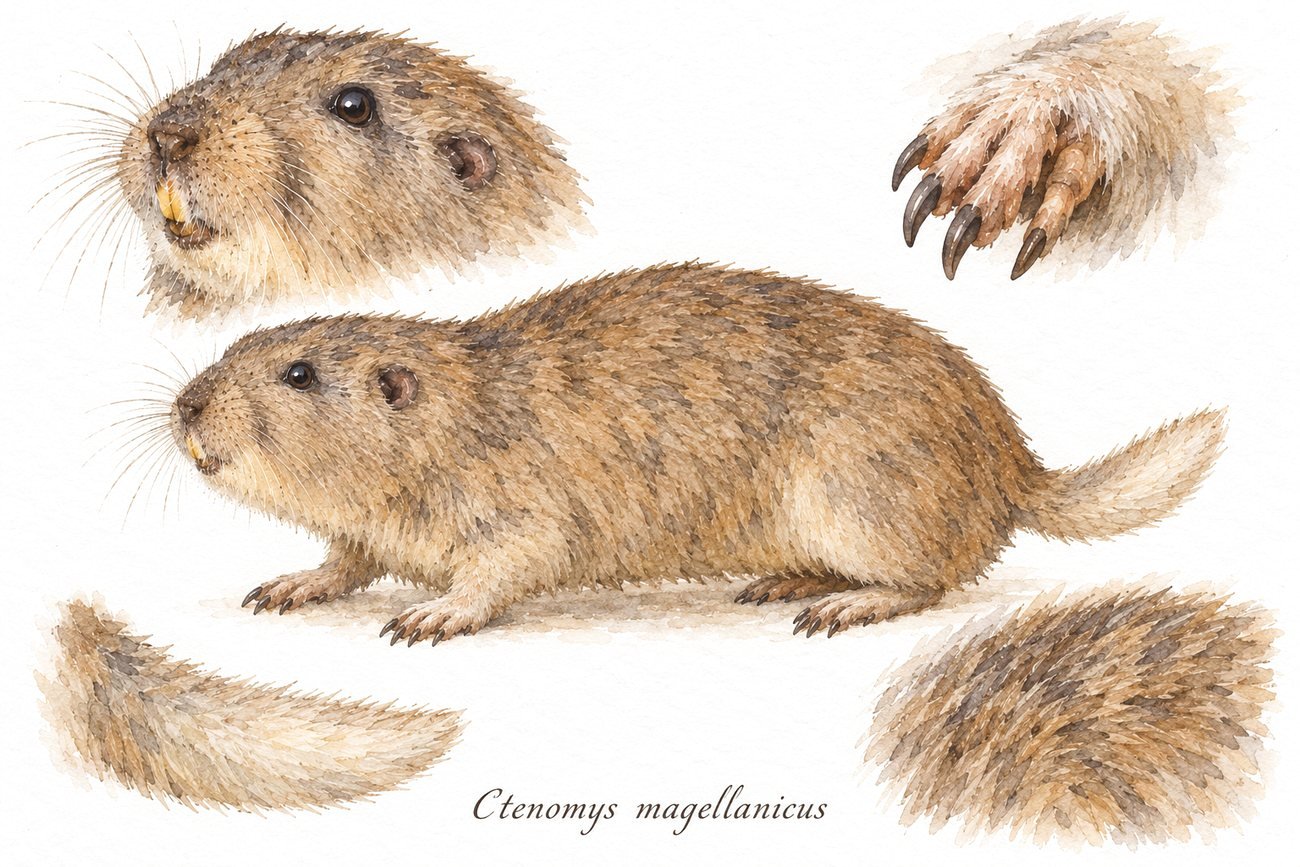
El tuco tuco de Magallanes es un roedor cavador que pasa casi toda su vida en galerías bajo la estepa y los pastizales del extremo sur de Chile y Argentina. Tiene el cuerpo cilíndrico y macizo, la cabeza grande, las orejas casi escondidas en el pelaje y unos incisivos amarillentos muy salientes con los que, junto a las garras de las manos, va abriendo túneles.The Magellanic tuco-tuco is a burrowing rodent that spends almost its whole life in galleries under the steppe and grasslands of the far south of Chile and Argentina. It has a cylindrical, solid body, a large head, ears almost hidden in the fur and very prominent yellowish incisors with which, along with the claws of its forefeet, it opens tunnels.
Es de tamaño mediano para su género: el cuerpo mide alrededor de 20 cm y la cola, corta y peluda, unos pocos centímetros más. El pelaje es denso, pardo grisáceo a canela, con el vientre más pálido.It is of medium size for its genus: the body measures around 20 cm and the short, furry tail a few centimeters more. The coat is dense, grayish brown to cinnamon, with a paler belly.
La especie se divide en varias subespecies. En la isla grande de Tierra del Fuego vive Ctenomys magellanicus fueginus, en el norte, centro y oriente de la isla. En Chile el Comité de Clasificación de Especies las clasificó como Vulnerables, y en Argentina la especie también está considerada Vulnerable. La única subespecie declarada extinta es C. m. dicki, que vivía en el extremo nororiental de la isla Riesco, en el continente.The species is divided into several subspecies. On the Isla Grande de Tierra del Fuego lives Ctenomys magellanicus fueginus, in the north, center and east of the island. In Chile the Species Classification Committee listed them as Vulnerable, and in Argentina the species is also considered Vulnerable. The only subspecies declared extinct is C. m. dicki, which lived at the northeastern end of Riesco Island, on the mainland.
Datos curiososWorth knowing
Un nombre que es un sonidoA name that is a sound
Tuco tuco imita el golpeteo que hacen estos roedores bajo tierra, que puede oírse desde la superficie.Tuco tuco imitates the knocking these rodents make underground, which can be heard from the surface.
Cava con dientes y manosIt digs with teeth and hands
Usa los incisivos para soltar tierra dura y las garras para empujarla hacia atrás. Sus labios cierran por detrás de los dientes, así puede cavar sin tragar tierra.It uses its incisors to loosen hard earth and its claws to push it backward. Its lips close behind the teeth, so it can dig without swallowing soil.
Cómo reconocerlaHow to recognize it
Lo más probable es que identifiques al tuco tuco por sus rastros: hileras de montículos de tierra suelta, sin hoyo abierto a la vista, sobre suelos blandos de vega o estepa. Si llegas a ver al animal asomado, es un roedor rechoncho de pelaje pardo canela, cabeza ancha, ojos y orejas pequeños, incisivos anaranjados bien visibles y cola corta clara. En Magallanes y Tierra del Fuego no hay otro roedor con esa combinación de cuerpo de topo y dientes al frente.You are most likely to identify the tuco-tuco by its traces: rows of mounds of loose earth, with no open hole in sight, on the soft ground of wet meadow or steppe. If you do get to see the animal at the entrance, it is a chunky rodent with a cinnamon-brown coat, a broad head, small eyes and ears, clearly visible orange incisors and a short pale tail. In Magallanes and Tierra del Fuego there is no other rodent with that combination of mole-like body and teeth out front.
SeñasField marks
Montículos de tierraMounds of earth
Hileras de montones de tierra fresca en estepa, vegas secas y campos, con la boca de la galería tapada.Rows of heaps of fresh earth on steppe, dry meadows and fields, with the mouth of the gallery plugged.
Incisivos al frenteIncisors out front
Dientes amarillos a anaranjados, grandes y salientes, visibles aun con la boca cerrada.Yellow to orange teeth, large and projecting, visible even with the mouth closed.
Cuerpo de cavadorA digger's body
Cilíndrico y macizo, con patas cortas, manos con garras largas y orejas diminutas.Cylindrical and solid, with short legs, forefeet with long claws and tiny ears.
Cola corta y claraShort pale tail
Cola breve, peluda y blanquecina, mucho más corta que el cuerpo.A short, furry, whitish tail, much shorter than the body.
Cuándo verlaWhen to see it
Todo el añoAll yearDe díaBy dayResidenteResident
Está todo el año. Los montículos frescos son más fáciles de encontrar en primavera y verano, cuando el suelo no está congelado.It is present all year. Fresh mounds are easiest to find in spring and summer, when the ground is not frozen.
Dónde buscarlaWhere to look
Estepa de coirón y vegas con suelo blando y sin rocas, en el norte de Tierra del Fuego y en la estepa continental de Magallanes. Busca hileras de montículos de tierra suelta junto a caminos de ripio y en campos ganaderos. Hay una colonia asentada en el Parque Pingüino Rey, en la costa de Bahía Inútil, sobre el camino que entra a la isla.Tussock steppe and wet meadows with soft, stone-free ground, in northern Tierra del Fuego and on the mainland steppe of Magallanes. Look for rows of mounds of loose earth beside gravel roads and in grazing country. There is a settled colony at Parque Pingüino Rey, on the shore of Useless Bay, along the road into the island.
No la confundas conDo not confuse it with
Coruro y otros roedores cavadores
Cuerpo compacto de excavador y vida en galerías. En Magallanes y Tierra del Fuego no hay coruros; un roedor de cuerpo de topo con montículos de tierra en la estepa austral es casi seguro un tuco tuco.A compact digger's body and life in galleries. In Magallanes and Tierra del Fuego there are no coruros; a rodent with a mole-like body and mounds of earth on the southern steppe is almost certainly a tuco-tuco.
Más sobre esta especieMore about this species+
Macho y hembraMale and female
Macho y hembra se ven iguales en terreno; no hay diferencias de color ni de forma que sirvan para distinguirlos a simple vista.Male and female look the same in the field; there are no differences of color or shape that help tell them apart by eye.
VozVoice
Desde bajo tierra emite un golpeteo repetido que suena como tuc-tuc, el origen del nombre del género. Se oye mejor si te quedas quieto cerca de los montículos.From underground it gives a repeated knocking that sounds like tuc-tuc, the origin of the genus name. It is heard better if you stay still near the mounds.
ComportamientoBehaviour
Vive solo en su sistema de galerías, que defiende de otros tuco tucos. Sale poco a la superficie, en general apenas lo justo para cortar plantas cerca de la boca del túnel, y vuelve a tapar la entrada con tierra. Su presencia se nota más por el sonido y los montículos que por verlo.It lives alone in its system of galleries, which it defends from other tuco-tucos. It comes to the surface little, generally just long enough to cut plants near the mouth of the tunnel, and plugs the entrance with earth again. Its presence shows more through sound and mounds than by being seen.
DietaDiet
Herbívoro: come pastos, raíces y partes subterráneas de plantas, que alcanza desde sus galerías o corta cerca de la entrada.Herbivorous: it eats grasses, roots and the underground parts of plants, which it reaches from its galleries or cuts near the entrance.
ReproducciónBreeding
Las crías nacen en cámaras dentro del sistema de túneles. Los detalles de la temporada reproductiva en la población fueguina están poco documentados.The young are born in chambers within the tunnel system. The details of the breeding season in the Fuegian population are poorly documented.
Origen del nombreWhere the name comes from
Ctenomys viene del griego ktenos, peine, y mys, ratón: alude a las cerdas en forma de peine de sus patas traseras. Magellanicus indica la región de Magallanes, donde fue descrito.Ctenomys comes from the Greek ktenos, comb, and mys, mouse: it alludes to the comb-like bristles on its hind feet. Magellanicus points to the Magallanes region, where it was described.
Mitos y erroresMyths and mistakes
Es fácil confundir los montículos con los de un topo. En Sudamérica no hay topos verdaderos: en la estepa austral esos montones son obra del tuco tuco.It is easy to mistake the mounds for a mole's. There are no true moles in South America: on the southern steppe those heaps are the work of the tuco-tuco.
AmenazasThreats
El sobrepastoreo ovino degrada su hábitat, y la especie ha disminuido en abundancia y distribución. En Chile está clasificado como Vulnerable; la subespecie de isla Riesco, C. m. dicki, se considera extinta.Overgrazing by sheep degrades its habitat, and the species has fallen in abundance and range. In Chile it is listed as Vulnerable; the Riesco Island subspecies, C. m. dicki, is considered extinct.
Ficha técnicaTechnical sheet+
- Otros nombresOther names
- Tuco-tuco magallánico, Magellanic tuco-tuco (inglés)Tuco-tuco magallánico, Magellanic tuco-tuco (English)
- FamiliaFamily
- Ctenomyidae · Orden:Order: Rodentia
- OrigenOrigin
- Nativa de Chile y ArgentinaNative to Chile and Argentina
- Estado de conservaciónConservation status
- Chile: Vulnerable · RCE, noveno proceso (2013)
- Estado de conservaciónConservation status
- Argentina: Amenazada · Res. 316/2021 (2021)Argentina: Threatened · Res. 316/2021 (2021)
- Dónde viveWhere it lives
- Chile · Regiones: Aysén y MagallanesChile · Regions: Aysén and Magallanes
8 fuentes8 sources+
- Acta RCE 4, noveno proceso, 26 septiembre 2012
- Estado de conservación en Chile:Conservation status in Chile: DS 29/2011 MMA (Reglamento); nómina consolidada del 20.º proceso, 8-jun-2026
- Estado de conservación en Argentina:Conservation status in Argentina: Resolución MAyDS 316/2021, Anexo I (Boletín Oficial, 24-sep-2021)
- Distribución: RCE (Ministerio del Medio Ambiente de Chile) (rce_mma_2026-03)Distribution: RCE (Ministerio del Medio Ambiente de Chile) (rce_mma_2026-03)
- Colonia del Parque Pingüino Rey, Bahía Inútil: observación en terreno del equipo de Explora.The colony at Parque Pingüino Rey, Useless Bay: field observation by the Explora team.
- Retrato: ilustración de Explora, generada con IA y revisada por el equipo.Portrait: illustration by Explora, generated with AI and reviewed by the team.
- Lámina: ilustración de Explora, generada con IA y revisada por el equipo.Plate: illustration by Explora, generated with AI and reviewed by the team.
- Texto: Explora, redactado con asistencia de IA.Text: Explora, written with AI assistance.
Otras de mamíferos terrestresMore land mammals