
Cultura y antropologíaCulture and anthropology
La caza selk'nam del guanacoThe Selk'nam Guanaco Hunt
Lucas Bridges, que vivió con los selk'nam, escribió que cazar guanacos en el bosque era un arte. Siempre había uno de centinela en un alto, y su grito de alarma «sonaba como una carcajada burlona».Lucas Bridges, who lived among the Selk'nam, wrote that hunting guanacos in the forest was an art. One guanaco always stood sentry on a rise, and its warning cry “sounded like a derisive laugh.”
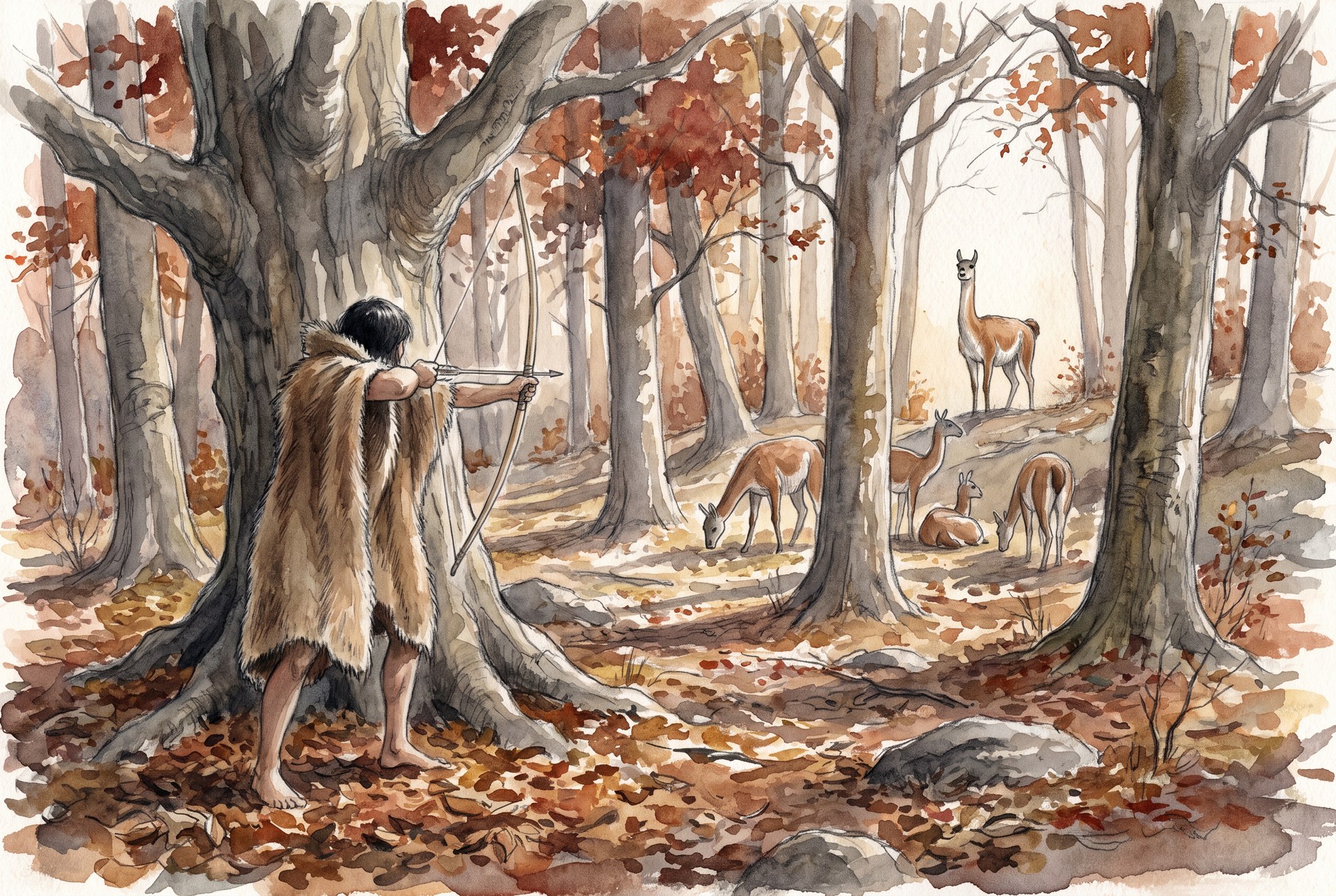
La caza del guanaco en el bosque de lenga, con el arco de madera blanca y el centinela en lo alto. Ilustración de Explora.The guanaco hunt in the lenga forest, with the bow of pale wood and the lookout above. Illustration by Explora.
En la lengua selk'nam, jepr quería decir a la vez carne de guanaco y comida. La antropóloga franco-norteamericana Anne Chapman, que trabajó desde 1965 con los últimos selk'nam que habían conocido la vida antigua, escribió que el guanaco era la presa preferida, por delante del zorro, del tuco tuco, un roedor del tamaño de una rata grande, de las aves y de los lobos marinos. Un guanaco adulto daba más de cien kilos de carne y huesos, más de lo que pesa un hombre, según Lucas Bridges, el hijo del misionero anglicano de Ushuaia, que vivió y cazó con los selk'nam. Con todo, el sacerdote y etnólogo alemán Martin Gusinde, que estuvo entre ellos entre 1919 y 1923, calculó que a una familia de seis personas un guanaco grande no le duraba más de cuatro o cinco días.In the Selk'nam language, jepr meant both guanaco meat and food. The French-American anthropologist Anne Chapman, who worked from 1965 with the last Selk'nam who had known the old way of life, wrote that the guanaco was the preferred prey, ahead of the fox, the tuco-tuco—a rodent the size of a large rat—birds and sea lions. An adult guanaco yielded more than a hundred kilos of meat and bone, more than a man weighs, according to Lucas Bridges, the son of the Anglican missionary in Ushuaia, who lived and hunted with the Selk'nam. Even so, the German priest and ethnologist Martin Gusinde, who was among them between 1919 and 1923, calculated that a large guanaco lasted a family of six no more than four or five days.
El arco y la flechaThe Bow and Arrow
Cada cazador hacía sus armas. El arco salía de la lenga, y Bridges contó que se usaba solo la madera blanca que hay bajo la corteza, porque el corazón del árbol es rojo y no servía. Se derribaba el árbol, se cortaba un tronco de algo más de un metro veinte y se partía hasta sacar una pieza sin nudos. Un buen fabricante de arcos le dejaba unas veinticinco caras planas, cada una más angosta hacia las puntas, y a los que mejor los hacían se les daba un título. La cuerda era de tendón trenzado de la pata delantera del guanaco.Each hunter made his own weapons. Bows were made from lenga, and Bridges recounted that only the white wood beneath the bark was used, because the heart of the tree is red and was no good. They felled the tree, cut a log just over 1.2 meters long and split it until they had a piece without knots. A good bowmaker shaped it into about twenty-five flat faces, each narrowing toward the ends. Those who made the best bows were given a title. The bowstring was braided sinew from the guanaco's foreleg.
«El extranjero ha espantado y matado a tiros a nuestros guanacos; ¿de qué hemos de vivir?»“The foreigner has scared off our guanacos and shot them dead; what are we to live on?”
Las flechas eran de dos arbustos del mismo género, Berberis. El calafate servía, pero la mejor madera, según Bridges y Gusinde, era la del michay (Berberis ilicifolia), de hojas grandes y espinosas, que crece en los bosques del sur de la isla. Medían entre sesenta y ochenta centímetros, más o menos el largo de un brazo. Llevaban dos plumas de ala de ganso o de cisne, y para los hombres diestros se elegían las del ala izquierda, porque el corte de sus barbas se dejaba amarrar mejor.The arrows came from two shrubs of the same genus, Berberis. The calafate would do, but the best wood, according to Bridges and Gusinde, was that of the michay (Berberis ilicifolia), with large, spiny leaves, which grows in the forests of the south of the island. They measured between sixty and eighty centimeters, roughly the length of an arm. They were fletched with two feathers from a goose or swan wing. For right-handed men, feathers from the left wing were chosen, because the cut of their barbs let them be bound on better.
La punta era de pedernal, y cuando empezaron a quedar botellas vacías por donde pasaban los colonos también se hizo de vidrio. El tallador sostenía el trozo sobre un cojín de piel de zorro y le sacaba astillas con un hueso seco de la pata de un guanaco. Trabajaba dos o tres puntas a la vez y guardaba las que esperaban turno dentro de la boca, para que el frío no las volviera quebradizas.Points were made of flint and, once the settlers began leaving empty bottles wherever they passed, of glass as well. The knapper held the piece on a cushion of fox skin and took flakes off it with a dry bone from a guanaco's leg. He worked two or three points at a time and kept those waiting their turn inside his mouth, so the cold would not make them brittle.
Dos maneras de acercarseTwo Ways to Approach
Gusinde describió una caza con perros. El selk'nam salía casi siempre solo con ellos, y cuando daban con un rastro corrían detrás del guanaco y lo rodeaban ladrando. El cazador llegaba corriendo y disparaba a unos veinte o treinta metros, la distancia de una cancha de tenis, apuntando al cuello, y los perros acorralaban al animal herido hasta que caía. A veces salían cuatro u ocho hombres y cercaban una manada entera. Chapman agregó los nombres de esa caza en grupo, en la que unos hombres, los hoijen, espantaban a los guanacos hacia donde otros, los hoipen, esperaban escondidos.Gusinde described a hunt with dogs. The Selk'nam hunter almost always went out alone with them. When they picked up a trail, they ran after the guanaco and surrounded it, barking. The hunter came running and shot from some twenty or thirty meters, the length of a tennis court, aiming at the neck, and the dogs held the wounded animal at bay until it fell. Sometimes four or eight men went out and encircled an entire herd. Chapman adds the names used in that group hunt, in which some men, the hoijen, drove the guanacos toward others, the hoipen, who waited in hiding.
Qué eran esos perros sigue en discusión. Chapman los describe como animales domésticos que había que adiestrar para la caza, y entre quienes los ven como perros, unos creen que los trajeron los europeos y otros que llegaron del norte con los antiguos pobladores, aunque en los sitios arqueológicos de la isla nunca han aparecido restos de perros domésticos. Otros investigadores piensan que eran culpeos amansados, porque el único perro selk'nam cuyo ADN se ha analizado, un ejemplar embalsamado que se guarda en un museo de Río Grande, resultó casi idéntico al zorro culpeo.What those dogs were is still debated. Chapman describes them as domestic animals that had to be trained to hunt. Among those who see them as dogs, some believe the Europeans brought them and others that they came from the north with the ancient inhabitants, although remains of domestic dogs have never been found at the island's archaeological sites. Other researchers think they were tamed culpeo foxes, because the only Selk'nam dog whose DNA has been analyzed, an embalmed specimen kept in a museum in Río Grande, turned out to be almost identical to the culpeo fox.
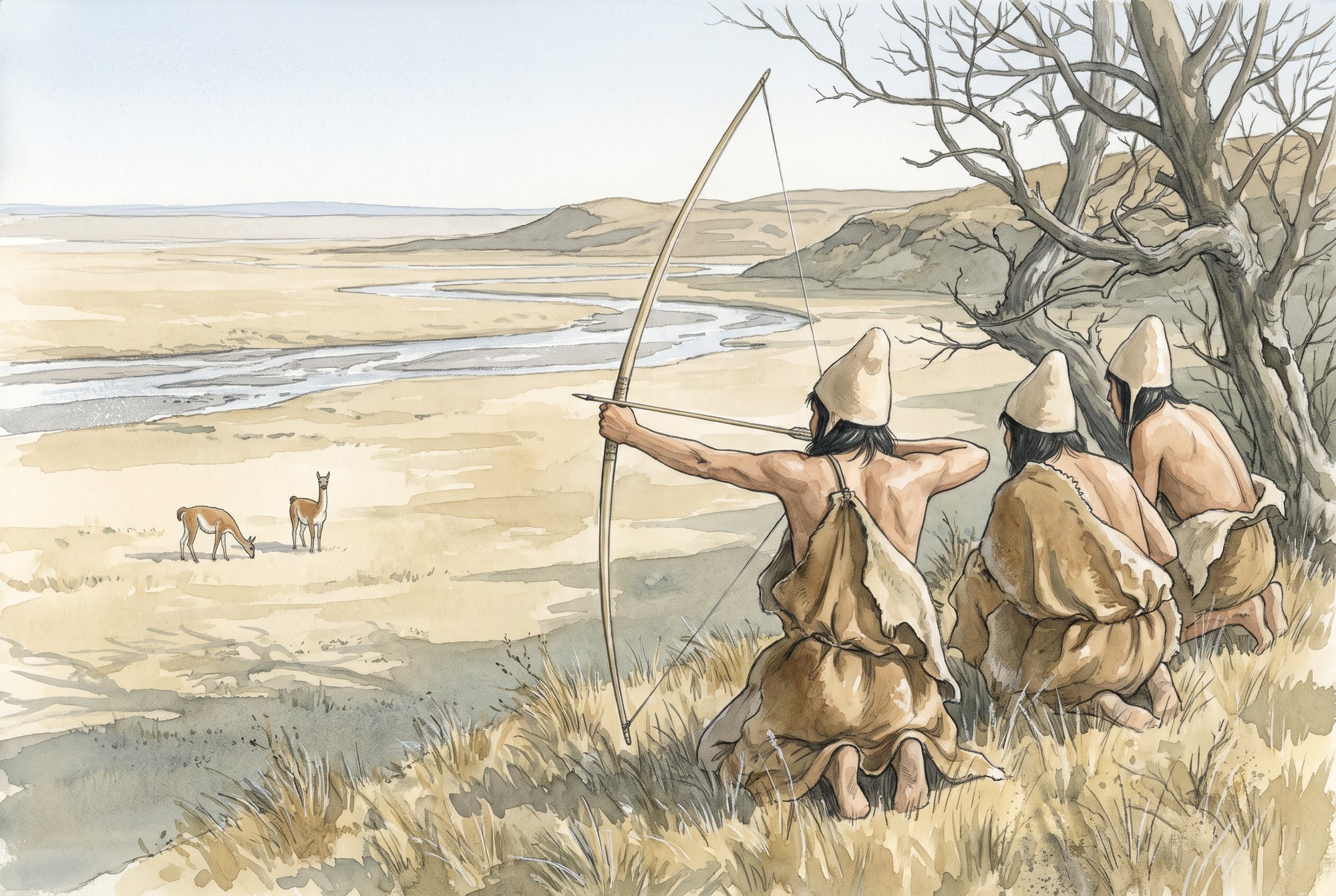
Cazadores selk'nam al acecho en la estepa, junto a un río. Ilustración de Explora.Selk'nam hunters lying in wait on the steppe, beside a river. Illustration by Explora.
Bridges, que también cazó guanacos en el bosque, escribió que hacerlo era un arte. Siempre había un guanaco de centinela en un alto, y su grito de alarma, que «sonaba como una carcajada burlona», corría por el bosque delante del cazador y ponía en guardia a todos los demás. El cazador se acercaba a cubierto todo lo que podía, dejaba ahí su capa y su carcaj, la funda de las flechas, y avanzaba con dos o tres flechas cruzadas en la boca. El mejor momento para disparar era cuando el guanaco se daba cuenta del peligro y se giraba para huir, porque entonces la flecha entraba detrás de las costillas y avanzaba sin tocar hueso. Bridges vio un guanaco con la pluma apenas asomada detrás de las costillas y la punta saliendo por la base del cuello.Bridges, who also hunted guanacos in the forest, wrote that doing so was an art. There was always a guanaco standing sentry on a rise, and its warning cry, which “sounded like a derisive laugh,” carried through the forest ahead of the hunter and put all the others on their guard. The hunter crept forward under cover as far as he could, left behind his cape and his quiver, the case for his arrows, and went on with two or three arrows crossed in his mouth. The best moment to shoot was when the guanaco sensed the danger and turned to flee, because then the arrow went in behind the ribs and drove on without touching bone. Bridges saw a guanaco with the feather barely showing behind the ribs and the point coming out at the base of the neck.
Los dos coinciden en que el cazador se quitaba la capa antes de tirar, y discrepan en los perros. Gusinde los pone en el centro de la caza. Bridges, después de una salida en que un grupo yámana había cazado antes con perros en la zona, anotó que espantaban a los animales en un área mucho mayor que el arco o el rifle. Chapman cuenta que a los muchachos se les enseñaba a manejar el arco, la flecha y los perros, y que las mujeres solo mataban guanacos muy jóvenes, con un garrote y ayudadas por perros, cuando no había un hombre que pudiera hacerlo.Both agree that the hunter took off his cape before shooting. They differ, however, on the dogs. Gusinde puts them at the center of the hunt. Bridges, after an outing in an area where a Yámana group had earlier hunted with dogs, noted that they scared the animals off over a much larger area than the bow or the rifle did. Chapman recounts that boys were taught to handle the bow, the arrow and the dogs, and that women killed only very young guanacos, with a club and with the help of dogs, when there was no man who could do it.
Un guanaco herido podía correr kilómetros antes de echarse. El cazador lo seguía, esperaba a que se debilitara y después volvía a buscar las flechas que habían fallado, porque eran demasiado valiosas para perderlas. El invierno facilitaba la caza, porque el guanaco dejaba huellas en la nieve, andaba en manadas más grandes y bajaba de los cerros a los valles y a la costa, y a comienzos del invierno todavía estaba gordo y la nieve blanda apagaba los pasos.A wounded guanaco could run for kilometers before lying down. The hunter followed it, waited for it to weaken and then went back for the arrows that had missed, because they were too valuable to lose. Winter made hunting easier, because the guanaco left tracks in the snow, moved in larger herds and came down from the hills to the valleys and the coast. Early in winter it was also still fat, and the soft snow muffled footsteps.
El repartoThe Sharing
Una tarde, en isla Navarino, Bridges y un grupo de cerca de veinte selk'nam volvieron al campamento con las manos vacías, todos menos Talimeoat y su hijo, que llegaron tarde y con carne. El guanaco venía en seis atados, como solían cortarlo. Talimeoat lo repartió pedazo por pedazo. Lanzaba cada porción hacia el hombre que le tocaba. El que la recibía hacía como si no se diera cuenta. Al final, él y su hijo se quedaron sin nada, ni siquiera con el pecho del animal, que era la parte del que lo había cazado. Entonces algunos partieron sus porciones y les devolvieron un poco. Bridges escribió que esa era la forma correcta de hacerlo entre los selk'nam. Gusinde también anotó que, del reparto de una presa, nadie se iba con las manos vacías.One afternoon, on Navarino Island, Bridges and a group of about twenty Selk'nam returned to camp empty-handed, all except Talimeoat and his son, who arrived late and with meat. The guanaco came in six bundles, the way they used to butcher it. Talimeoat shared it out piece by piece. He tossed each portion toward the man whose turn it was. The one who received it acted as if he had not noticed. In the end, he and his son were left with nothing, not even the animal's brisket, which was the hunter's share. Then some of the others split their portions and gave a little back to them. Bridges wrote that this was the proper way to do it among the Selk'nam. Gusinde also noted that, when a kill was shared, no one went away empty-handed.
Todo el animalThe Whole Animal
Chapman hizo la lista de lo que se sacaba de un guanaco. La sangre se tomaba fresca o se cocinaba como prieta, embutida en un intestino del mismo animal, y la médula era un manjar. Con la grasa que sobraba se hacía la pintura del cuerpo. El cuero sobado cubría los paravientos, las carpas y las chozas cónicas de troncos, y con la piel se hacían las capas que todos usaban, la envoltura de las mujeres, los tocados, las sandalias, las polainas y hasta las pelotas para jugar, y de la vejiga salían bolsitas. Con los tendones se trenzaban cuerdas, lazos, la cuerda del arco, trampas para aves, redes de pesca y collares. El hueso de la canilla, por lo duro, servía para el retocador, la herramienta con que se afinaba el filo de las puntas, y para la punta del arpón.Chapman made a list of what was taken from a guanaco. The blood was drunk fresh or cooked as blood sausage, stuffed into an intestine from the same animal. The marrow was a delicacy. The leftover fat was used to make body paint. Tanned hide covered the windbreaks, the tents and the conical log huts. The skin was made into the capes everyone wore, the women's wraps, headdresses, sandals, leggings and even balls for games, and the bladder into small pouches. The sinews were braided into cords, lassos, the bowstring, bird snares, fishing nets and necklaces. The shin bone, being so hard, was used for the retoucher, the tool for sharpening the edge of the points, and for the harpoon head.
Cuando llegaron las estancias, desde la década de 1880, el guanaco se volvió más escaso y más arisco con el ir y venir de personas, caballos y ovejas, y los selk'nam empezaron a cazar ovejas. Gusinde recogió cómo lo explicaban: «El extranjero ha espantado y matado a tiros a nuestros guanacos; ¿de qué hemos de vivir?».With the arrival of the estancias, from the 1880s on, the guanaco became scarcer and warier amid the comings and goings of people, horses and sheep, and the Selk'nam began to hunt sheep. Gusinde recorded how they explained it: “The foreigner has scared off our guanacos and shot them dead; what are we to live on?”
En el centro de la isla, el camino cruza Pampa Guanaco y, más al sur, entra en un bosque de lengas, el árbol del que los selk'nam sacaban la madera blanca de sus arcos.In the center of the island, the road crosses Pampa Guanaco and, farther south, enters a forest of lenga, the tree from which the Selk'nam took the white wood for their bows.
10 fuentes10 sources+
- Bridges, E. L. (1948). Uttermost part of the Earth. Hodder & Stoughton.
- Chapman, A. (2002). Fin de un mundo: los selknam de Tierra del Fuego (2.ª ed.). Taller Experimental Cuerpos Pintados. Memoria Chilena. https://www.memoriachilena.gob.cl/archivos2/pdfs/MC0043450.pdf
- Explora. (2026). Rutas de exploraciones y puntos de interés de Tierra del Fuego [Conjunto de datos geográficos no publicado, archivos KMZ].
- Franklin, W. L. (2025). Foxes as pets: Case study of the Fuegian Dog and its relationship to extinct Indigenous cultures. Journal of Zoology, 327(1), 5–18. https://doi.org/10.1111/jzo.70031
- Gusinde, M. (1951). Hombres primitivos en la Tierra del Fuego (de investigador a compañero de tribu) (D. Bermúdez Camacho, Trad.). Escuela de Estudios Hispano-Americanos de Sevilla. Memoria Chilena. https://www.memoriachilena.gob.cl/archivos2/pdfs/MC0004214.pdf
- Jaksic, F. M. y Castro, S. A. (2023). The identity of Fuegian and Patagonian “dogs” among indigenous peoples in southernmost South America. Revista Chilena de Historia Natural, 96, Artículo 5. https://doi.org/10.1186/s40693-023-00119-z
- Jaksic, F. M., Zurita, C., Briceño, C. y Jiménez, J. E. (2024). The rare Fuegian fox (Lycalopex culpaeus) from the Tierra del Fuego Archipelago: History of discovery, geographic distribution, and socio-ecological aspects. Revista Chilena de Historia Natural, 97, Artículo 1. https://doi.org/10.1186/s40693-024-00124-w
- Martínez-Crovetto, R. (1968). Estudios etnobotánicos IV: nombres de plantas y su utilidad, según los indios onas de Tierra del Fuego. Etnobiológica, (3), 1–20. https://doi.org/10.30972/etn.032150
- Moraga, C. A., Funes, M. C., Pizarro, J. C., Briceño, C. y Novaro, A. J. (2015). Effects of livestock on guanaco Lama guanicoe density, movements and habitat selection in a forest–grassland mosaic in Tierra del Fuego, Chile. Oryx, 49(1), 30–41. https://doi.org/10.1017/S0030605312001238
- Nota. Las citas de Bridges son traducción propia del inglés. El peso de cien kilos de Bridges, el cálculo de Gusinde sobre la familia de seis personas y la frase de los selk'nam sobre las ovejas se toman de Chapman (2002), que cita la edición castellana de Bridges y la traducción de Gusinde de 1982. Las medidas de una cancha de tenis y del brazo son conocimiento general, y la conversión de pies a metros es cálculo propio. El análisis genético del ejemplar de Río Grande (Petrigh y Fugassa, 2013) y las hipótesis sobre la llegada del perro se toman de Jaksic y Castro (2023) y Franklin (2025).Note. Bridges's quotation is given in his original English. Bridges's hundred-kilo weight, Gusinde's calculation for the family of six and the Selk'nam statement about the sheep are taken from Chapman (2002), who cites the Spanish edition of Bridges and the 1982 translation of Gusinde; the Selk'nam statement is our translation from the Spanish. The dimensions of a tennis court and of an arm are general knowledge, and the conversion from feet to meters is our own calculation. The genetic analysis of the Río Grande specimen (Petrigh & Fugassa, 2013) and the hypotheses about the dog's arrival are taken from Jaksic and Castro (2023) and Franklin (2025).
Lo que sale aquíWhat appears here
Seguir por los pueblos de la islaMore on the peoples of the island
Fauna · 3 minWildlife · 3 min
Los guanacos del bosque fueguinoThe Guanacos of the Fuegian Forest
En el continente, un guanaco que entra al bosque arriesga la vida, porque ahí el puma lo acecha sin ser visto. En Tierra del Fuego no hay pumas, y la …On the mainland, a guanaco that enters the forest risks its life, because there the puma stalks it unseen. Tierra del Fuego has no pumas, and most of …
Cultura y antropología · 24 minCulture and anthropology · 24 min
El Hain, la ceremonia selk'namThe Hain, the Selk'nam Ceremony
«¡El último de nosotros debe llevarse a la tumba este secreto de los hombres!», les repetía en 1923 el chamán Tenenesk a los dos muchachos que iban a …“The last of us must carry this secret of the men to the grave!” the shaman Tenenesk told the two boys again and again in 1923, as they were about to …