
Cultura y antropologíaCulture and anthropology
El Hain, la ceremonia selk'namThe Hain, the Selk'nam Ceremony
«¡El último de nosotros debe llevarse a la tumba este secreto de los hombres!», les repetía en 1923 el chamán Tenenesk a los dos muchachos que iban a hacerse adultos en el Hain, la gran ceremonia selk'nam.“The last of us must carry this secret of the men to the grave!” the shaman Tenenesk told the two boys again and again in 1923, as they were about to become adults in the Hain, the great Selk'nam ceremony.
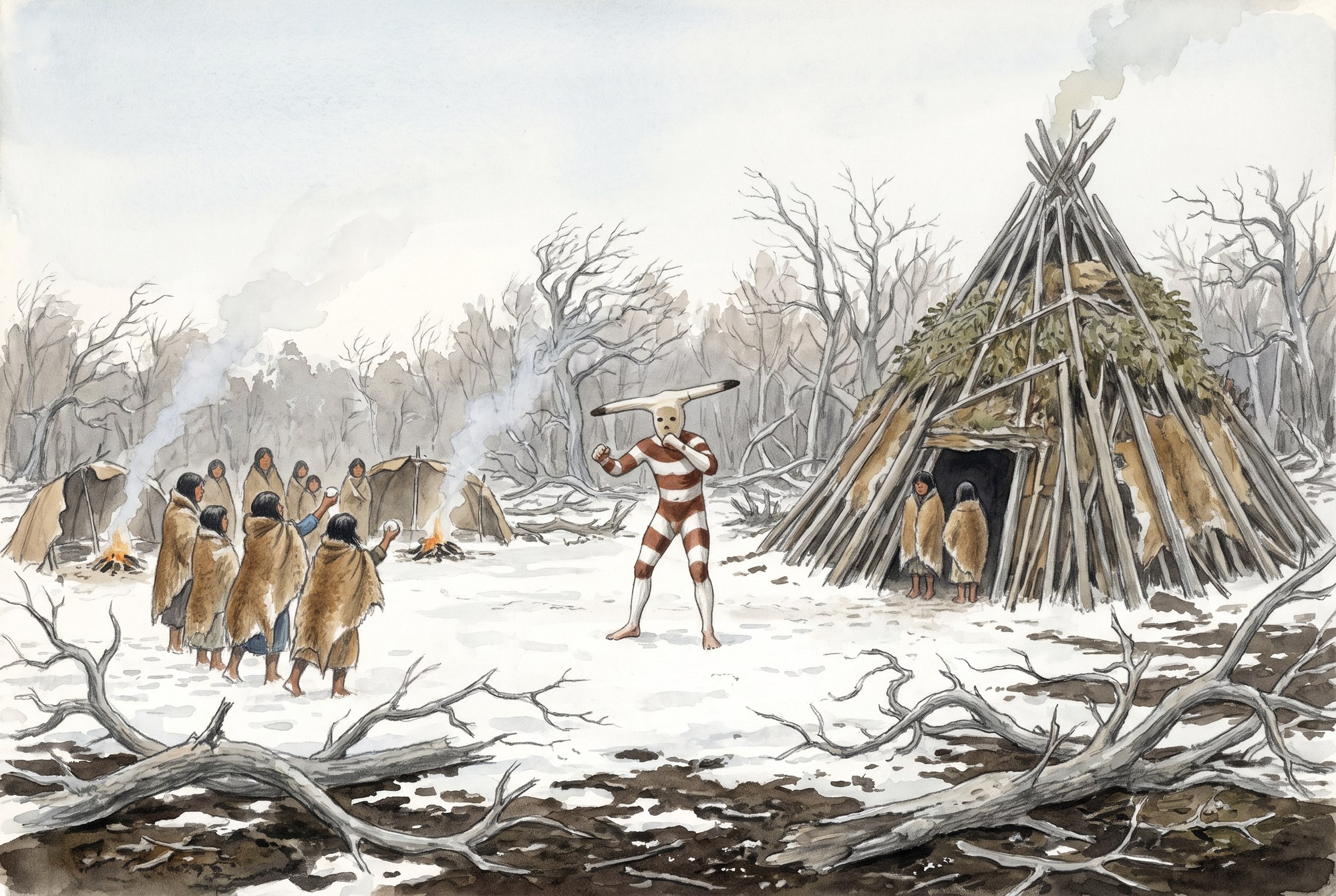
Entre el campamento y la choza del Hain había unos 190 pasos. Ilustración de Explora.Between the camp and the Hain hut there were some 190 paces. Illustration by Explora.
A las tres de la tarde del 22 de mayo de 1923, desde una choza de troncos recién levantada, se oyó un coro de hombres. La choza estaba en un prado cerca de la orilla oriental del Lago Fagnano, en el lado argentino de la isla. A unos 190 pasos, en el campamento, las mujeres y los niños se acurrucaron en sus chozas a esperar. El sacerdote y etnólogo alemán Martin Gusinde esperaba en la suya, porque al comienzo lo trataban como a uno de los muchachos que iban a ser iniciados. «Aquellos aullidos amenazadores crearon también en mí un estado de ánimo desagradable», escribió. Con ellos empezaba el Hain. Ese año duró cincuenta días, unas siete semanas.At three in the afternoon on May 22, 1923, a chorus of men rang out from a newly raised log hut. The hut stood in a meadow near the eastern shore of Lake Fagnano, on the Argentine side of the island. Some 190 paces away, in the camp, the women and children huddled in their huts to wait. The German priest and ethnologist Martin Gusinde waited in his, because at first he was treated as one of the boys who were to be initiated. “Those threatening howls created an unpleasant mood in me as well,” he wrote. With them, the Hain began. That year it lasted fifty days, about seven weeks.
Qué era el HainWhat the Hain Was
Para los selk'nam era la ceremonia más importante. Su propósito principal era iniciar a los muchachos, que durante meses aprendían de los mayores. La antropóloga franco-norteamericana Anne Chapman, que trabajó con los últimos selk'nam que conocieron la vida antigua, le vio otros dos. Servía para mantener a las mujeres bajo el dominio de los hombres. También juntaba a familias que rara vez se veían y calmaba los conflictos entre ellas.For the Selk'nam it was the most important ceremony. Its main purpose was to initiate the boys, who spent months learning from their elders. The French-American anthropologist Anne Chapman, who worked with the last Selk'nam to have known the old way of life, saw two other purposes in it. It served to keep women under the rule of men. It also brought together families who seldom saw one another and eased the conflicts between them.
«¡El último de nosotros debe llevarse a la tumba este secreto de los hombres!»“The last of us must carry this secret of the men to the grave!”
Ningún muchacho se libraba. Si los mayores no quedaban conformes, podía tener que repetirlo. Nadie se casaba antes de terminar. Para las niñas no había una iniciación de este tipo. Mientras pasaba por la ceremonia, al muchacho lo llamaban klóketen. Los últimos selk'nam, cuando hablaban en castellano, le decían al Hain «el colegio». Federico Echeuline, hijo de madre selk'nam, lo explicó así. «Klóketen era como un alumno que está en el colegio, estudiando. Pero para ellos no era estudio, sino para que sea alentado, que tenga energía para trabajar, para levantarse».No boy was exempt. If the elders were not satisfied, he might have to go through it again. No one married before finishing it. There was no initiation of this kind for girls. While he was going through the ceremony, the boy was called a klóketen. The last Selk'nam, when they spoke Spanish, called the Hain el colegio, “the school.” Federico Echeuline, whose mother was Selk'nam, explained it this way. “A klóketen was like a pupil who is at school, studying. But for them it wasn't study, it was so that he would be encouraged, so that he would have energy to work, to get up.”
No tenía fecha fija. Se hacía cuando había muchachos en edad de entrar y caza suficiente para alimentar a muchas familias. Lo común era que durara dos o tres meses. El de 1922 duró cuatro meses, con un solo candidato, el hijo del chamán Tenenesk. Antes podía pasar del año. Tenenesk se acordaba del suyo. «¡Cuando yo fui Klóketen todavía había muchos, muchos hombres! Venían de todas las regiones de la isla», le contó a Gusinde. «Dos veranos y un invierno estuvimos reunidos».It had no fixed date. It was held when there were boys of the right age and enough game to feed many families. It usually lasted two or three months. The one in 1922 lasted four months, with a single candidate, the son of the shaman Tenenesk. In earlier times it could go on for more than a year. Tenenesk remembered his own. “When I was a Klóketen there were still many, many men! They came from every part of the island,” he told Gusinde. “Two summers and one winter we stayed together.”
Gusinde anotó que, después de largos períodos de paz, llegaban a juntarse 250 hombres o más. Venían del norte y del sur de la isla, y también de los haush, el pueblo del extremo sudeste. Chapman calculó que podían reunirse unas trescientas personas. Si los selk'nam y los haush eran entre 3.500 y 4.000 antes de 1880, como estimaba Gusinde, era cerca de uno de cada doce. La isla estaba repartida en territorios, los haruwen, cada uno de un linaje y con límites que los vecinos respetaban. Mientras duraba el Hain, cualquier familia podía cruzarlos. En 1923, los selk'nam del norte y los del sur celebraron cada uno el suyo. El del Fagnano fue el del sur, con dos candidatos de 14 y 16 años.Gusinde noted that, after long periods of peace, as many as 250 men or more might gather. They came from the north and the south of the island, and also from the Haush, the people of the far southeast. Chapman estimated that some three hundred people could come together. If the Selk'nam and the Haush numbered between 3,500 and 4,000 before 1880, as Gusinde estimated, that would be nearly one in every twelve. The island was divided into territories, the haruwen, each belonging to one lineage, with boundaries its neighbors respected. While the Hain lasted, any family could cross them. In 1923, the northern and the southern Selk'nam each held their own. The one at Fagnano was the southern one, with two candidates aged 14 and 16.
El mito de origenThe Origin Myth
Los mayores explicaban el Hain con un mito. Ocurrió en el hóowin, el tiempo de los orígenes, cuando el sol, la luna, las estrellas y los vientos andaban por la tierra como personas. Entonces mandaban las mujeres. Los hombres mantenían el fuego, asaban la carne, trabajaban los cueros y cuidaban a los niños. No podían sentarse en la rueda donde ellas decidían. La más poderosa era Luna, chamana y esposa de Sol.The elders explained the Hain with a myth. It took place in the hóowin, the time of origins, when the sun, the moon, the stars and the winds walked the earth as people. Back then, women ruled. The men kept the fire going, roasted the meat, worked the hides and looked after the children. They could not sit in the circle where the women made decisions. The most powerful woman was Moon, a shaman and the wife of Sun.
Las mujeres temían que los hombres, más fuertes, se rebelaran. Por eso levantaron una choza grande lejos de las viviendas. Ahí se pintaban el cuerpo, se ponían máscaras de corteza y salían convertidas en espíritus que, según les decían a sus maridos, bajaban del cielo o subían desde la tierra. Uno de ellos, Xalpen, exigía carne. Los hombres cazaban sin descanso para dársela.The women feared that the men, who were stronger, would rebel. So they built a large hut far from the dwellings. There they painted their bodies, put on bark masks and came out transformed into spirits that, they told their husbands, came down from the sky or rose up from the earth. One of them, Xalpen, demanded meat. The men hunted tirelessly to give it to her.
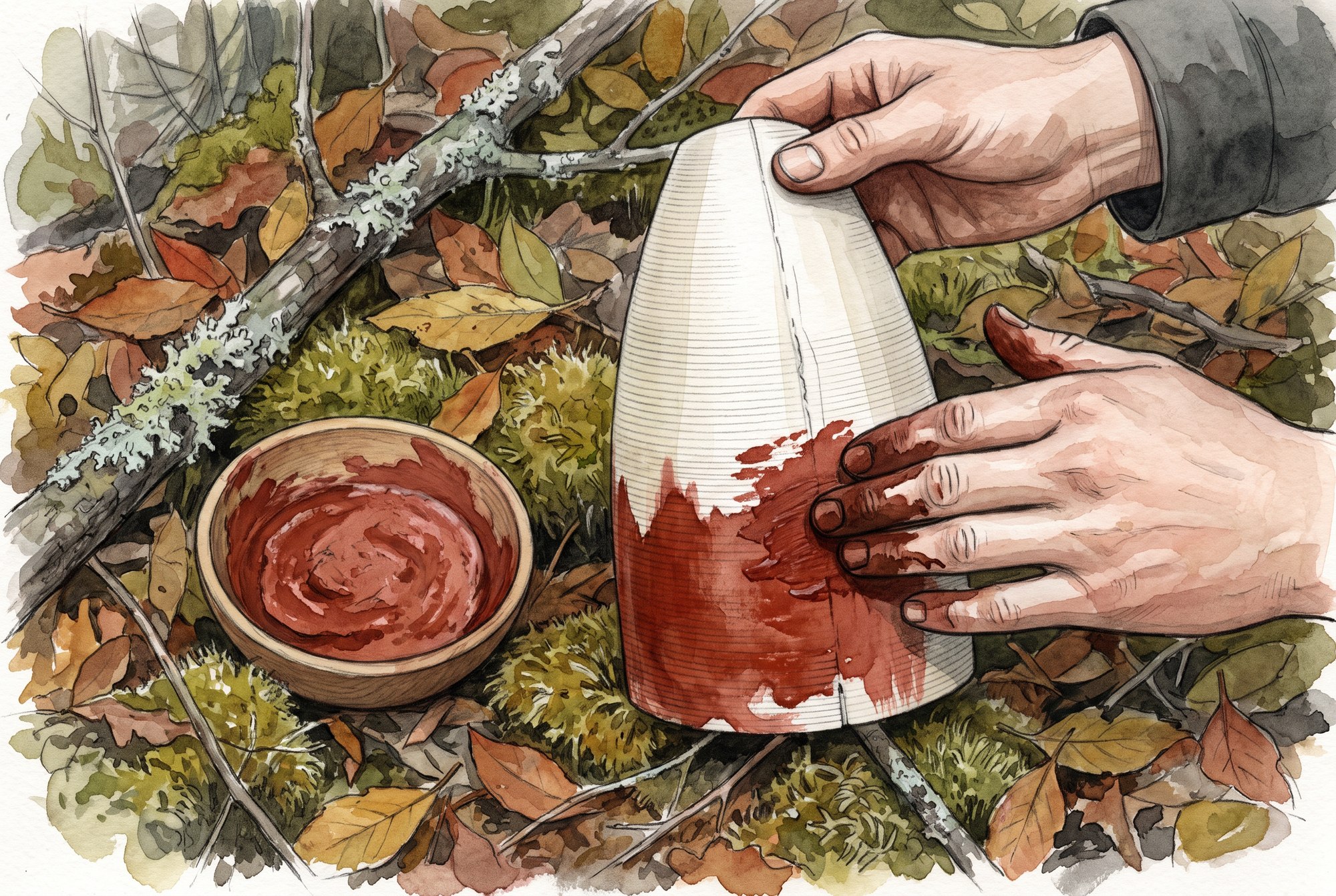
Una máscara de corteza, pintada antes de entrar a la choza. Ilustración de Explora.A bark mask, painted before entering the hut. Illustration by Explora.
Un día, Sol volvía de cazar con un guanaco a la espalda y se sentó a descansar detrás de un arbusto, junto a una laguna. En la orilla, dos muchachas pintadas como uno de esos espíritus ensayaban sus pasos y se reían de los hombres, que creían que los espíritus existían. «¡Cómo se asombrarán los hombres!», decían. Sol salió de su escondite. «¡Ahora lo sé todo!», les gritó.One day, Sun was returning from the hunt with a guanaco on his back and sat down to rest behind a bush, beside a lagoon. On the shore, two girls painted as one of those spirits were rehearsing their steps and laughing at the men, who believed the spirits were real. “How amazed the men will be!” they said. Sun came out of his hiding place. “Now I know everything!” he shouted at them.
Sol fue de choza en choza contándoles a los hombres lo que había visto. Mandaron a tres de los más rápidos a cruzar corriendo la choza de las mujeres. Los tres vieron solo mujeres sentadas, cada una con su máscara detrás. Armados con garrotes, los hombres asaltaron la choza y mataron a todas las mujeres, menos a las niñas pequeñas, que no sabían del engaño.Sun went from hut to hut telling the men what he had seen. They sent three of the fastest to run straight through the women's hut. All three saw only women sitting there, each with her mask behind her. Armed with clubs, the men stormed the hut and killed all the women, except the little girls, who knew nothing of the deception.
Luna cayó al fuego y escapó al cielo con la cara quemada, convertida en la luna. Sol la persigue desde entonces sin alcanzarla. Las manchas de la luna son sus cicatrices. Según el mito, Luna nunca perdonó a los hombres. Cuando entraba en eclipse, decían los selk'nam, era porque seguía enojada con ellos. Si se ponía roja, era por la sangre de los que iban a morir en las batallas siguientes.Moon fell into the fire and escaped to the sky with her face burned, transformed into the moon. Sun has pursued her ever since without catching her. The spots on the moon are her scars. According to the myth, Moon never forgave the men. When she went into eclipse, the Selk'nam said, it was because she was still angry with them. If she turned red, it was because of the blood of those who would die in the coming battles.
Después los hombres se pintaron como los mismos espíritus. La ceremonia pasó a ser de ellos. Desde entonces fueron ellos los que guardaban el secreto, y se lo revelaban a cada muchacho en el Hain, junto con este mito.Afterward, the men painted themselves as those same spirits. The ceremony became theirs. From then on, it was they who kept the secret, and they revealed it to each boy in the Hain, along with this myth.
Chapman recogió otra versión, en que el engaño lo descubrieron tres hombres que sorprendieron a una mujer pintándose para hacer de Matan, uno de los espíritus selk'nam. Bridges oyó una tercera, en que las mujeres dominaban con la brujería, hasta que a los hombres se les ocurrió que «una bruja muerta era menos peligrosa que una viva».Chapman recorded another version, in which the deception was discovered by three men who caught a woman painting herself to play Matan, one of the Selk'nam spirits. Bridges heard a third, in which the women ruled through witchcraft, until it occurred to the men “that a dead witch was less dangerous than a live one.”
Para los hombres que se lo contaron a Gusinde, el mito decía cómo habían sido las cosas al principio. Chapman lo leyó como una ideología que explicaba el poder de los hombres sobre las mujeres y al mismo tiempo lo justificaba. Lo resumió como «la derrota del matriarcado mitológico frente al patriarcado real».For the men who told it to Gusinde, the myth told how things had been in the beginning. Chapman read it as an ideology that explained men's power over women and, at the same time, justified it. She summed it up as “the defeat of the mythological matriarchy by the real patriarchy.”
La preparaciónThe Preparation
No había un jefe que lo convocara. Según Gusinde, algunos hombres empezaban a comentar que sería bueno celebrar uno. Los vecinos se enteraban y se sumaban. Otros mandaban mensajeros a invitar a amigos y parientes.There was no chief to call it. According to Gusinde, some men would begin to remark that it would be good to hold one. The neighbors heard of it and joined in. Others sent messengers to invite friends and relatives.
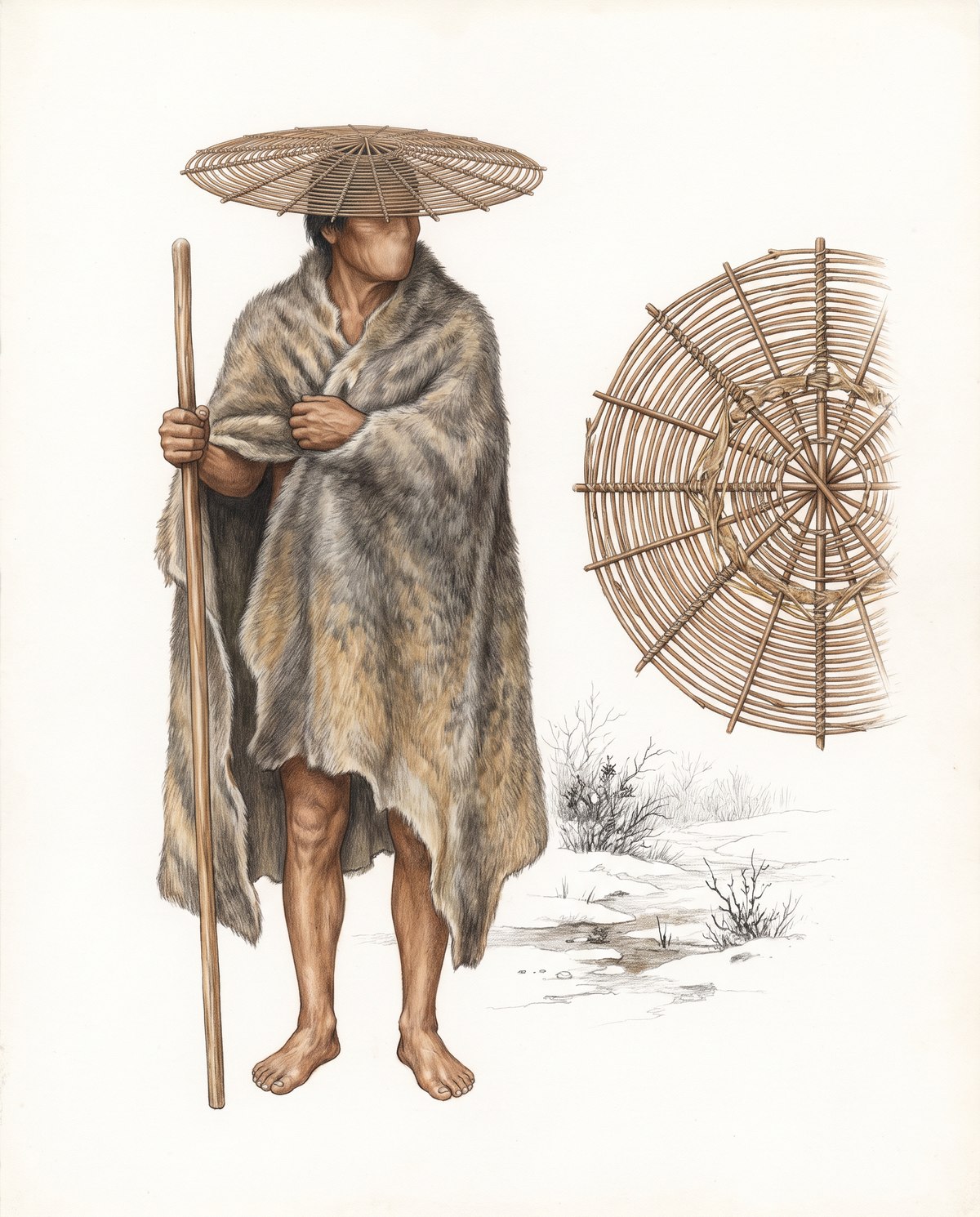
Hashé, uno de los espíritus que salían de la choza del Hain. Ilustración de Explora.Hashé, one of the spirits that came out of the Hain hut. Illustration by Explora.
Los mayores elegían a los candidatos. Más que la edad, miraban el carácter. Gusinde anotó las preguntas que se hacían. «¿Sabe callar? ¿Ha dejado de jugar con niños pequeños?», empezaban, y terminaban con otra. «¿Sabrá valorar lo que significa nuestro secreto?». Sobre la edad no hay acuerdo. Gusinde calculó que en épocas anteriores el klóketen tenía en promedio unos diecinueve años. Bridges escribió que entraban entre los trece y los diecisiete.The elders chose the candidates. They looked at character more than age. Gusinde recorded the questions they asked themselves. “Can he keep quiet? Has he stopped playing with small children?” they began, and they ended with another. “Will he know how to value what our secret means?” There is no agreement about the age. Gusinde estimated that in earlier times the klóketen was on average about nineteen. Bridges wrote that they entered between thirteen and seventeen.
La dirección le tocaba por costumbre al padre del candidato mayor. Gusinde lo llamó inspector, y Chapman, consejero. Podía cederla a un hombre con más experiencia. En 1923 los titulares eran Halemink y su hijo Nana, pero mandaba Tenenesk, un chamán de origen haush que conocía como pocos las costumbres antiguas. Al director le correspondía decidir el lugar y el día del comienzo.By custom, leadership fell to the father of the oldest candidate. Gusinde called him the inspector, and Chapman, the counselor. He could hand it over to a man with more experience. In 1923 the official leaders were Halemink and his son Nana, but the one in charge was Tenenesk, a shaman of Haush origin who knew the old customs as few others did. It was up to the leader to decide the place and the day the ceremony would begin.
El sitio tenía que estar al borde de un bosque, con un prado detrás de la choza que hacía de escenario. Al otro lado del prado iba el campamento de las mujeres y los niños. Hacía falta agua cerca y guanacos para cazar. Solía empezar en otoño o a comienzos del invierno, cuando los guanacos estaban en su mayor peso. En 1923 se decidieron el 19 de mayo. Dos días después caminaron por el bosque hasta un prado de casi un kilómetro de largo, cerca de una laguna que llamaban, en castellano, «de Pescados». Para alimentar a los participantes, Gusinde compró ovejas en una estancia vecina. La cifra cambia según la fuente. Chapman escribió 300 en el original inglés de sus notas de 1977. En la edición castellana de 2002 aparecen 360, la cifra que da también el historiador Alberto Harambour. Son entre seis y siete ovejas por cada día de ceremonia.The site had to be at the edge of a forest, with a meadow behind the hut that served as a stage. On the far side of the meadow stood the camp of the women and children. Water had to be close by, and guanacos to hunt. It usually began in autumn or early winter, when the guanacos were at their heaviest. In 1923 they made the decision on May 19. Two days later they walked through the forest to a meadow almost a kilometer long, near a lagoon they called, in Spanish, “de Pescados” (“of the Fish”). To feed the participants, Gusinde bought sheep from a neighboring estancia. The figure varies by source. Chapman wrote 300 in the original English of her 1977 notes. The 2002 Spanish edition gives 360, the figure also given by the historian Alberto Harambour. That comes to between six and seven sheep for each day of the ceremony.
La choza se levantó entre la tarde del 21 y el mediodía del 22, con unos cincuenta troncos y bajo la dirección de Tenenesk. Primero iban siete postes principales, en un orden fijo. Cada uno llevaba el nombre de uno de los siete antepasados que, según el mito, construyeron la primera choza de los hombres. Cada poste correspondía además a uno de los cielos, los shó'on, ligados a los puntos cardinales. Cada hombre se sentaba junto al poste del cielo de su tierra. La de 1923 medía ocho metros de diámetro por dentro y casi seis de alto, como una casa de dos pisos. Por fuera la cubrían con champas, trozos de pasto con su tierra, que tapaban la luz del fuego y apagaban las voces. Desde la entrada, a través del fuego, corría una línea imaginaria. Nadie podía pisarla, porque era una grieta por la que subían algunos espíritus. La entrada miraba siempre al este. A Gusinde le dijeron que así lo habían querido los primeros antepasados. Bridges escribió que era por el viento, que viene del oeste, y para que el olor de la carne asada no llegara hasta las mujeres.The hut went up between the afternoon of the 21st and noon on the 22nd, with some fifty logs and under Tenenesk's direction. First came seven main posts, in a fixed order. Each bore the name of one of the seven ancestors who, according to the myth, built the first men's hut. Each post also corresponded to one of the skies, the shó'on, linked to the cardinal points. Each man sat beside the post of the sky of his own land. The 1923 hut measured eight meters across inside and almost six meters high, like a two-story house. On the outside it was covered with sods, blocks of grass cut out with their soil, which blocked the light of the fire and muffled the voices. From the entrance, through the fire, ran an imaginary line. No one could step on it, because it was a crack through which some of the spirits came up. The entrance always faced east. Gusinde was told that the first ancestors had wanted it that way. Bridges wrote that it was because of the wind, which comes from the west, and so that the smell of roasting meat would not reach the women.
Las máscaras se hacían de cuero de guanaco o de corteza, con plumas, y se rellenaban con hojas y pasto. Las pinturas iban del negro al blanco y del rojo oscuro al amarillo. La preferida era una arcilla con hierro llamada ákel, que al calentarla se volvía granate. También usaban tiza, carbón del fogón y huesos de guanaco quemados, mezclados con grasa o con saliva. Esas tierras de color las guardaban las mujeres en sus bolsas. Antes del Hain, los hombres les sacaban un poco a escondidas. Las mujeres y los niños nunca debían ver una máscara sin alguien adentro. Al terminar, las máscaras no se quemaban «por respeto». Se escondían en un tronco hueco del bosque hasta el Hain siguiente.The masks were made of guanaco hide or bark, with feathers, and stuffed with leaves and grass. The paints ranged from black to white and from dark red to yellow. The favorite was an iron-rich clay called ákel, which turned garnet-red when heated. They also used chalk, charcoal from the hearth and burned guanaco bones, mixed with fat or with saliva. The women kept these colored earths in their bags. Before the Hain, the men took a little in secret. The women and children must never see a mask without someone inside it. When it was over, the masks were not burned, “out of respect.” They were hidden in a hollow tree trunk in the forest until the next Hain.
Los participantesThe Participants
La mayoría de los hombres no hacía de espíritu. Los papeles importantes se repartían entre los mejores actores. En 1923, Tenenesk demoró el comienzo porque, decía, faltaban «ciertos hombres». Según Chapman, había quince, veinte o más espíritus, según cuántos hombres participaran.Most of the men did not play a spirit. The important roles were given to the best actors. In 1923, Tenenesk delayed the start because, he said, “certain men” were missing. According to Chapman, there were fifteen, twenty or more spirits, depending on how many men took part.
Cada iniciado, el klóketen, tenía un guía que lo acompañaba toda la ceremonia. Gusinde escribe que les tocaba a los iniciados de los años anteriores. En 1923 fueron Ambrosio y Tomás. Chapman lo llama supervisor, k'pin. A Bridges lo guió Aneki, con su hermano Shilchan de testigo.Each initiate, the klóketen, had a guide who accompanied him throughout the ceremony. Gusinde writes that this fell to the initiates of previous years. In 1923 they were Ambrosio and Tomás. Chapman calls him the supervisor, k'pin. Bridges was guided by Aneki, with his brother Shilchan as witness.
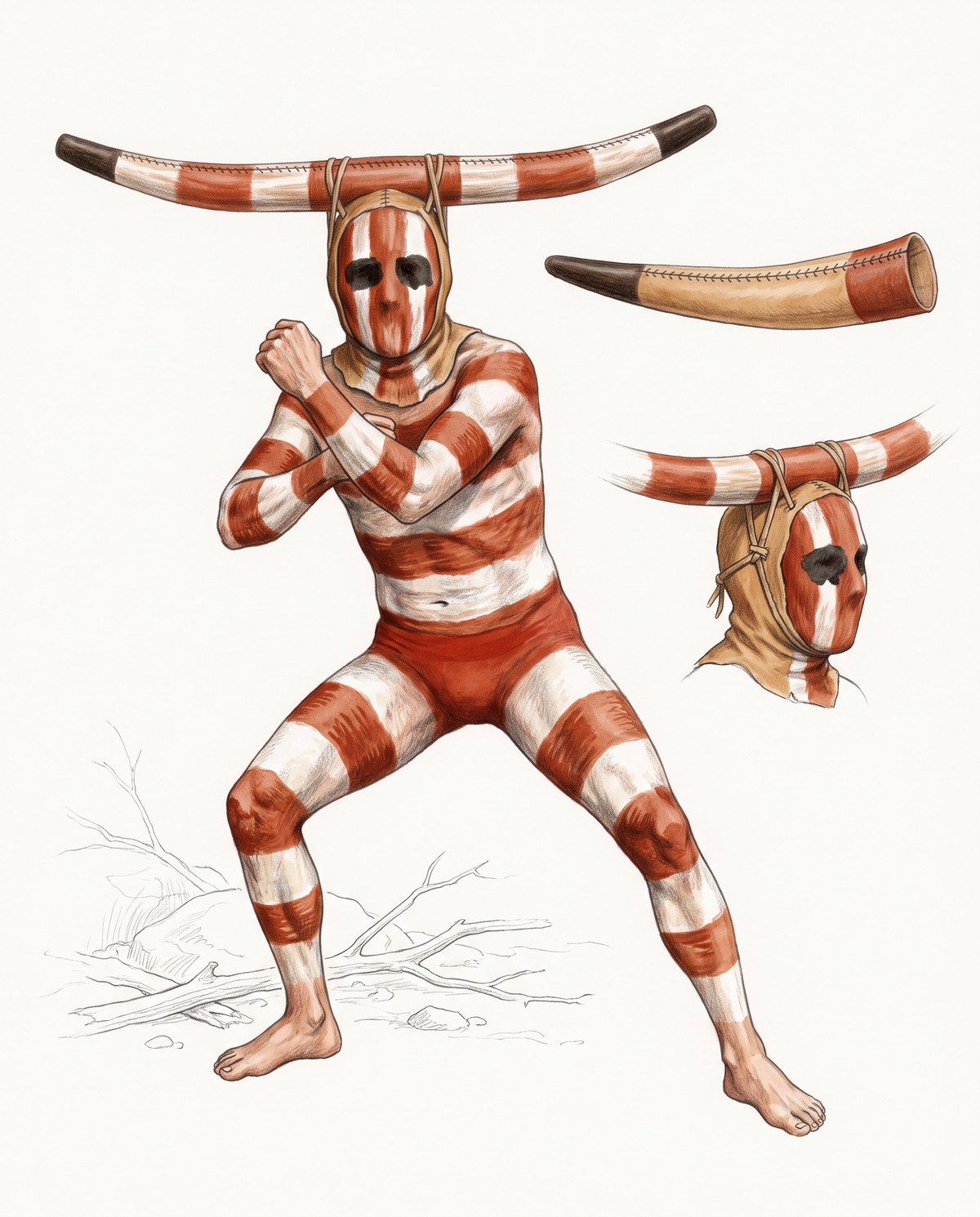
Kotaix, con su máscara de cuernos. Ilustración de Explora.Kotaix, with his horned mask. Illustration by Explora.
A las madres de los klóketen las llamaban kai-klóketen. Las demás mujeres cantaban, entregaban carne y pintura y obedecían a los espíritus. Los niños sentían el ambiente y jugaban menos que de costumbre. Un informante le contó a Chapman que una vez un niño reconoció, por su manera de caminar, al hombre que hacía de uno de los espíritus. Los muchachos que aún no conocían el secreto dormían en el campamento, con las mujeres.The mothers of the klóketen were called kai-klóketen. The other women sang, handed over meat and paint, and obeyed the spirits. The children sensed the mood and played less than usual. An informant told Chapman that a child once recognized the man playing one of the spirits by the way he walked. The boys who did not yet know the secret slept in the camp, with the women.
El primer díaThe First Day
El primer día empezaba con la pintura del klóketen. Su guía lo frotaba con una planta fibrosa y lo pintaba con ákel, una arcilla con hierro. Su madre le pintaba tres rayas verticales en la cara. Ese día ella llevaba la vincha de los hombres. Después venía la procesión hacia la choza. La madre caminaba a su lado llorando y se detenía a mitad del prado. Las mujeres y las niñas les tiraban ceniza.The first day began with the painting of the klóketen. His guide rubbed him down with a fibrous plant and painted him with ákel, an iron-rich clay. His mother painted three vertical stripes on his face. That day she wore the men's headband. Then came the procession toward the hut. The mother walked beside him weeping and stopped halfway across the meadow. The women and girls threw ashes at them.
Adentro, el klóketen esperaba desnudo frente al fuego, rodeado de los hombres pintados. De pronto saltaba delante de él Shoort, un espíritu enmascarado y mudo. Le apretaba los genitales hasta dejarlo temblando y después peleaba con él sin dejarse ganar. Esto se repetía durante varios días. Al final de una de esas peleas, le ordenaban tocarle la cabeza. «¿Es de piedra o de carne?», le preguntaban. El muchacho le sacaba la máscara, reconocía al hombre y lo botaba al suelo entre las risas de todos. Después le ponían una vincha triangular de piel de guanaco, el k'ochel, como símbolo de hombría.Inside, the klóketen waited naked before the fire, surrounded by the painted men. Suddenly Shoort, a masked and mute spirit, leaped out in front of him. He squeezed the boy's genitals until the boy was trembling, then wrestled with him without letting himself be beaten. This was repeated for several days. At the end of one of those bouts, the boy was ordered to touch the spirit's head. “Is it stone or flesh?” they asked him. The boy pulled off the mask, recognized the man and threw him to the ground amid everyone's laughter. Then they placed on his head a triangular headband of guanaco skin, the k'ochel, as a symbol of manhood.
Bridges vio la iniciación de un muchacho llamado K-Wamen y la contó de otra manera. El muchacho temblaba de miedo y su padre le cerraba la retirada. Lucharon entre las risas de todos. Shoort, que Bridges escribía Short, se dejó botar, como hacía siempre. Cuando K-Wamen supo quién era, se le fue encima otra vez y tuvieron que sacárselo. Bridges escribió que no había torturas como las de algunos pueblos de Norteamérica. Desde ese día, en las dos versiones, el muchacho conocía el secreto, que los espíritus eran hombres disfrazados.Bridges saw the initiation of a boy named K-Wamen and told it differently. The boy was shaking with fear and his father blocked his retreat. They wrestled amid everyone's laughter. Shoort, whom Bridges spelled Short, let himself be thrown, as he always did. When K-Wamen learned who he was, he went at him again and they had to pull him off. Bridges wrote that there were no tortures like those of some peoples of North America. From that day on, in both versions, the boy knew the secret, that the spirits were men in disguise.
Los espíritusThe Spirits
Cada espíritu tenía su nombre, su pintura, su máscara, su canto y su manera de moverse, fijados por la tradición. Por esos rasgos las mujeres los reconocían. Algunos subían de la tierra y otros bajaban del cielo.Each spirit had its own name, painting, mask, chant and way of moving, all fixed by tradition. The women recognized them by those features. Some came up from the earth and others came down from the sky.
La más temida era Xalpen, una mujer caníbal que vivía bajo la tierra y subía a la choza a exigir carne. En 1923 se hacía oír en promedio cada tres días, con gritos, golpes en el suelo y chispas por la punta de la choza. Los hombres decían que los obligaba a acostarse con ella y que se llevaba a los klóketen bajo tierra. A las mujeres casi nunca se la mostraban, solo la oían. En 1923 la vieron una sola noche. Era un bulto de cueros de unos seis metros, más largo que un auto, que los hombres empujaban apenas por un costado de la choza. Gusinde escribió que buscaban darle el aspecto «de una ballena». Lola Kiepja, una chamana selk'nam que vivió varios Hain, y Angela Loij, que estuvo en el de 1923, le explicaron a Chapman que Xalpen era «mitad de piedra y mitad de carne». Bridges, que la escribía Halpen, oyó que era una hermana blanca que bajaba de las nubes.The most feared was Xalpen, a cannibal woman who lived beneath the earth and came up into the hut to demand meat. In 1923 she made herself heard on average every three days, with shrieks, blows on the ground and sparks shooting from the top of the hut. The men said she forced them to sleep with her and that she carried the klóketen off underground. She was almost never shown to the women, who only heard her. In 1923 they saw her on a single night. She was a bundle of hides some six meters long, longer than a car, which the men pushed only a little way out along one side of the hut. Gusinde wrote that they tried to give her the appearance “of a whale.” Lola Kiepja, a Selk'nam shaman who lived through several Hain ceremonies, and Angela Loij, who was at the one in 1923, explained to Chapman that Xalpen was “half stone and half flesh.” Bridges, who spelled her Halpen, heard that she was a white sister who came down from the clouds.
Su marido era Shoort, el único espíritu que salía todos los días y el único enmascarado que entraba al campamento. Había siete principales, uno por cada cielo, cada uno con su pintura. En 1923 actuó más que ninguno el del sur, porque la laguna quedaba en su territorio. Chapman escribe que el espíritu de Shoort «era de piedra». Por eso el que lo hacía no debía dejar ver que respiraba. Movía la cabeza a tirones, como una lechuza, y nunca hablaba.Her husband was Shoort, the only spirit who came out every day and the only masked one who entered the camp. There were seven main ones, one for each sky, each with its own painting. In 1923 the one from the south performed more than any other, because the lagoon lay in his territory. Chapman writes that the spirit of Shoort “was of stone.” That is why the man who played him could not let anyone see him breathe. He moved his head in jerks, like an owl, and he never spoke.
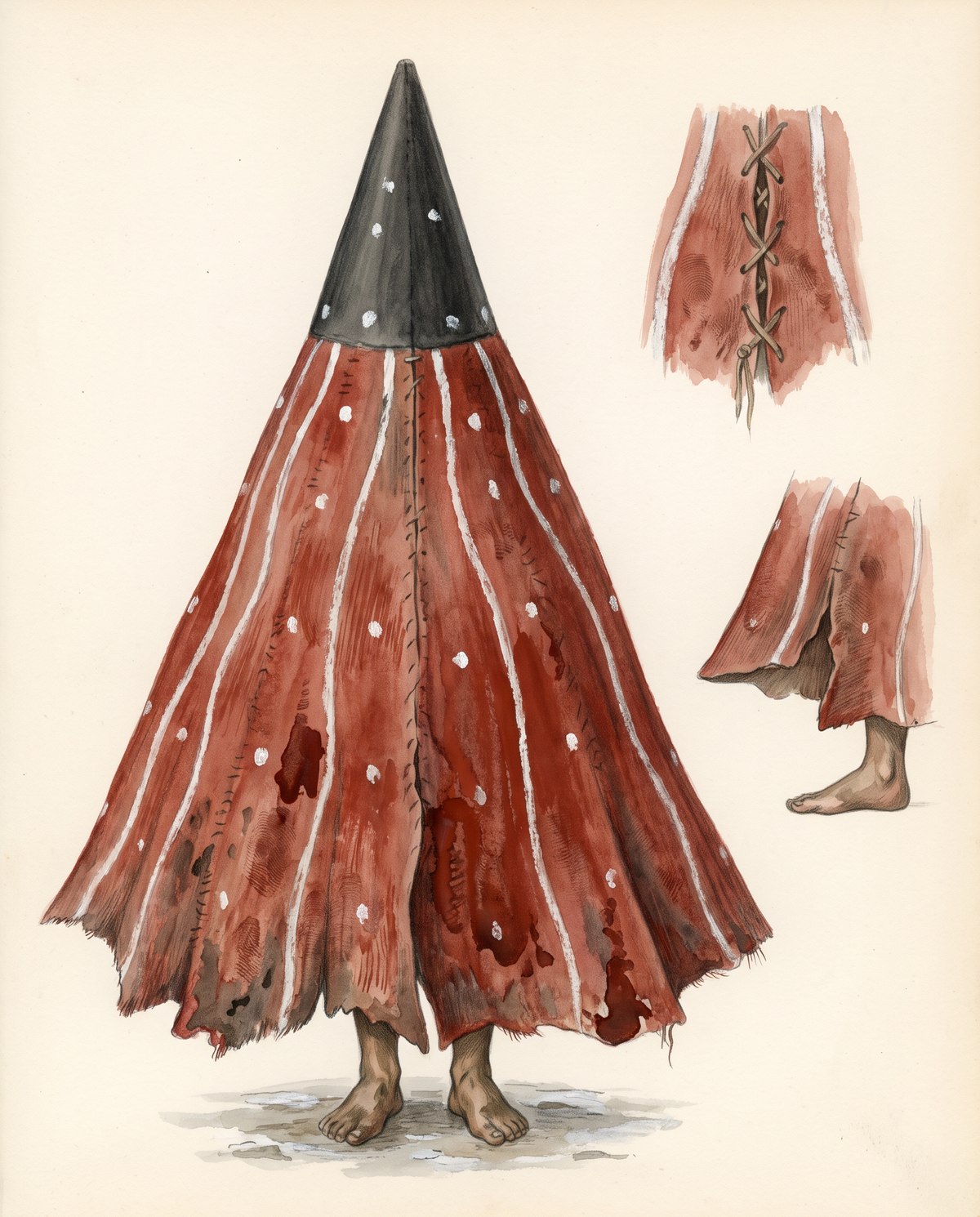
Xalpen, la mujer caníbal que subía del inframundo a exigir carne: el espíritu más temido del Hain. Ilustración de Explora.Xalpen, the cannibal woman who rose from the underworld to demand meat: the most feared spirit of the Hain. Illustration by Explora.
De noche llegaban al campamento Hashé y su mujer Wakús. Eran enviados de Xalpen y venían a pedir carne y pintura, sobre todo ákel. No llevaban máscara, solo la cara tiznada con carbón y una corona de ramas. Entraban a las chozas, atizaban el fuego hasta llenarlas de humo, hacían como que se tragaban las brasas y amenazaban a las mujeres con una vara. Ellas les seguían el juego y se reían. A Gusinde le recordaron la visita de Santa Claus.At night Hashé and his wife Wakús came to the camp. They were Xalpen's envoys and came to ask for meat and paint, above all ákel. They wore no masks, only charcoal-blackened faces and a crown of branches. They went into the huts, stirred up the fire until the huts filled with smoke, pretended to swallow the embers and threatened the women with a rod. The women played along and laughed. They reminded Gusinde of a visit from Santa Claus.
Kulan bajaba del cielo. Era joven y delgada, y siempre estaba rodeada de amantes. Las mujeres no le tenían mucha simpatía. Llevaba una máscara cónica, casi siempre roja, con una franja blanca de la punta hacia abajo. Casi siempre la hacía un klóketen que ya conocía el secreto. En 1923 tardó una hora en recorrer diez metros, lo que una persona camina en unos siete segundos. Su marido, Koshménk, la buscaba enfurecido y golpeaba las paredes de la choza cuando ella estaba adentro con otro. Las mujeres se reían de él. Lo hacían cuatro hombres, uno por cada punto cardinal, que saltaban golpeándose las nalgas con los pies.Kulan came down from the sky. She was young and slender, and always surrounded by lovers. The women did not care much for her. She wore a conical mask, almost always red, with a white stripe running down from the tip. She was almost always played by a klóketen who already knew the secret. In 1923 she took an hour to cover ten meters, a distance a person walks in about seven seconds. Her husband, Koshménk, searched for her in a fury and pounded on the walls of the hut when she was inside with another. The women laughed at him. He was played by four men, one for each cardinal point, who leaped about kicking their own buttocks.
Matan, que podía ser hombre o mujer, era el gran bailarín del Hain. Bajaba del cielo y daba unos saltos verticales que Chapman comparó con los del ballet. Las mujeres corrían al borde del prado gritando su nombre. Gusinde dio cuero para hacer dos máscaras de Matan y al final quiso llevárselas. Los hombres se negaron. Le explicaron que lo que entraba a la choza dejaba de ser de uno solo.Matan, who could be man or woman, was the great dancer of the Hain. Matan came down from the sky and made vertical leaps that Chapman compared to those of ballet. The women ran to the edge of the meadow shouting Matan's name. Gusinde supplied hide for two Matan masks and, at the end, wanted to take them with him. The men refused. They explained that whatever entered the hut no longer belonged to any one person.
Tanu, la hermana de Xalpen, subía del inframundo. Gusinde pensaba que podía ser un espíritu masculino. En 1923 sobrepasaba en noventa centímetros al hombre que la hacía. Su armazón de arcos, cueros y juncos lo tapaba entero, salvo las pantorrillas y los pies. El actor caminaba de espaldas al público, con pasos laterales y lentos, guiado por un anciano. Su escena era de noche, alrededor de una gran fogata. Los hombres bailaban en fila con la nariz sangrando, porque se la pinchaban con un palito. Las mujeres trataban de limpiarle la sangre a su favorito.Tanu, Xalpen's sister, came up from the underworld. Gusinde thought it might be a male spirit. In 1923 the figure stood ninety centimeters taller than the man who played it. Its frame of hoops, hides and rushes covered him entirely, except for his calves and feet. The actor walked with his back to the audience, with slow sideways steps, guided by an old man. Its scene took place at night, around a great bonfire. The men danced in a line with their noses bleeding, because they had pricked them with a small stick. The women tried to wipe the blood from their favorite.
De Ulen se sabe poco. Chapman lo llama el payaso del Hain. Gusinde anotó que su máscara no era un cono, como la de casi todos los demás.Little is known of Ulen. Chapman calls him the clown of the Hain. Gusinde noted that his mask was not a cone, unlike those of almost all the others.
La vida diariaDaily Life
Cada día, mucho antes del amanecer, las mujeres salían de sus chozas y se quedaban de pie junto a la entrada. Las madres de los klóketen empezaban el háichula, un canto de media hora que a Gusinde le pareció lúgubre. Lola le dijo a Chapman que llamaba al amanecer. Horas después saludaban al sol con otro, el yóroheu, que quiere decir amanecer.Every day, long before dawn, the women came out of their huts and stood by the entrance. The mothers of the klóketen began the háichula, a half-hour chant that Gusinde found mournful. Lola told Chapman that it summoned the dawn. Hours later they greeted the sun with another, the yóroheu, which means dawn.
Cuando Shoort salía hacia el campamento, los hombres lo anunciaban cantando. Las mujeres se metían en sus chozas, se tapaban con una piel de guanaco y cantaban mientras él estuviera ahí. Las madres de los klóketen se quedaban afuera, con la cabeza cubierta. Lo acompañaba siempre un chamán, que si había nieve iba tapando sus huellas, porque un espíritu no podía dejar pisadas de hombre. Si un marido se había quejado de su mujer, Shoort la buscaba. Podía limitarse a sacudirle la choza o a tirarle una canasta, pero también podía golpearla o echarle la choza abajo.When Shoort set out toward the camp, the men announced him with song. The women went into their huts, covered themselves with a guanaco skin and sang for as long as he was there. The mothers of the klóketen stayed outside, with their heads covered. He was always accompanied by a shaman, who, if there was snow, covered his tracks as they went, because a spirit could not leave human footprints. If a husband had complained about his wife, Shoort went after her. He might just shake her hut or throw a basket at her, but he might also beat her or tear her hut down.
Cuando oían los gritos de Xalpen, las mujeres corrían a dejarle canastas de hongos lo más cerca de la choza que se les permitía, compitiendo por llegar primero. Le cantaban hoshr k'lish choucha, «frente de piedra». Según Chapman, era un insulto que ellas querían que Xalpen tomara como un halago. Otras veces Xalpen mandaba a unos hombres al campamento a pedir carne. Las mujeres se la daban para calmarla. De vuelta en la choza, los hombres se la comían alrededor del fuego.When they heard Xalpen's shrieks, the women ran to leave her baskets of fungi as close to the hut as they were allowed, competing to arrive first. They sang to her hoshr k'lish choucha, “forehead of stone.” According to Chapman, it was an insult that the women wanted Xalpen to take as a compliment. At other times Xalpen sent some men to the camp to ask for meat. The women gave it to them to appease her. Back in the hut, the men ate it around the fire.
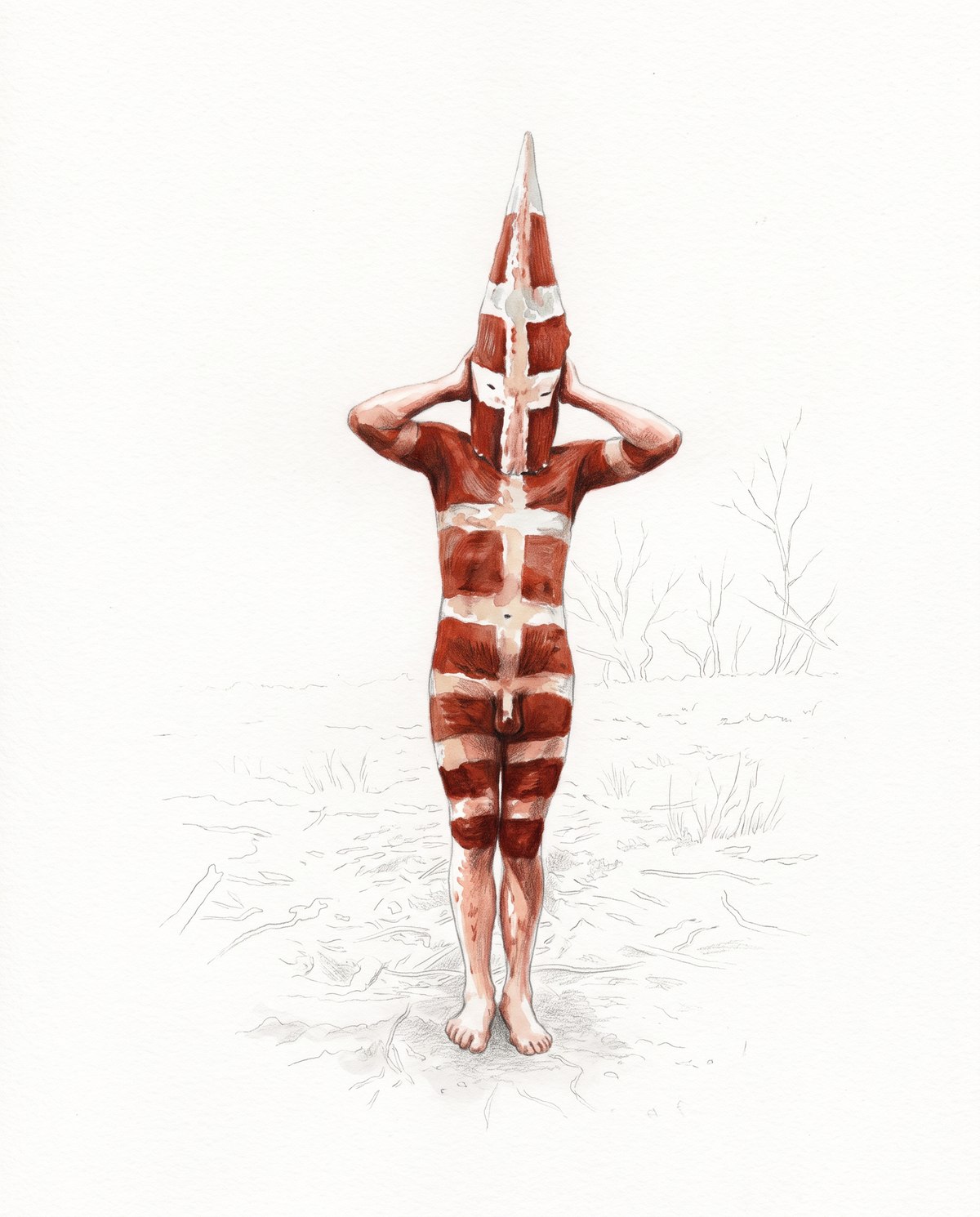
Kulan, que bajaba del cielo. Ilustración de Explora.Kulan, who came down from the sky. Illustration by Explora.
Algunos juegos los ganaban ellas. En uno, un grupo de jóvenes salía de la choza saltando como pingüinos. Se agachaban en medio del prado. Cada mujer elegía a uno, que tenía que ser un pariente con el que se pudiera bromear, y le tironeaba los mechones de pelo hasta botarlo. Él caía gritando como si lo mataran. «Por única vez las mujeres tenían la oportunidad de triunfar sobre los hombres», escribió Gusinde. Dentro de la choza, mientras tanto, los mayores pasaban horas contando sus cacerías y sus peleas de juventud. Para muchos, estar por fin «totalmente entre hombres» era uno de los atractivos del Hain.The women won some of the games. In one, a group of young men came out of the hut hopping like penguins. They crouched in the middle of the meadow. Each woman chose one, who had to be a relative with whom joking was allowed, and pulled at his tufts of hair until she knocked him over. He fell screaming as if he were being killed. “For once, the women had the chance to triumph over the men,” Gusinde wrote. Inside the hut, meanwhile, the elders spent hours telling of the hunts and fights of their youth. For many, being at last “entirely among men” was one of the attractions of the Hain.
Las reglas de los klóketenThe Rules of the Klóketen
El klóketen no podía hablar en la choza, salvo para responder. Se sentaba con las piernas estiradas y la vista fija en el fuego. Para rascarse usaba un palito, nunca las uñas. Comía poco y nunca el hígado ni el corazón del guanaco, ni tomaba su sangre. Bridges sumó a la lista de lo prohibido la médula, los sesos, los ojos y las tripas. Dormía poco y se pintaba todos los días. A veces lo despertaban antes del alba para salir a cazar durante tres o cuatro días. Mientras tanto, las madres le cantaban a Xalpen para calmarla. «Ahora [los klóketen] están lejos. Los tobillos cansados», decía uno de esos cantos.The klóketen could not speak in the hut, except to answer. He sat with his legs stretched out and his eyes fixed on the fire. To scratch himself he used a small stick, never his nails. He ate little, and never the liver or heart of the guanaco, nor did he drink its blood. Bridges added marrow, brains, eyes and guts to the list of forbidden foods. He slept little and painted himself every day. Sometimes he was woken before dawn to go hunting for three or four days. Meanwhile, the mothers sang to Xalpen to calm her. “Now [the klóketen] are far away. The tired ankles,” went one of those chants.
Le advertían una y otra vez que no podía contarle el secreto a una mujer ni a un niño. Si lo hacía, los matarían a los dos. Bridges escribió que nadie defendería al culpable, porque el hermano mataría al hermano y el padre al hijo. En 1923, Tenenesk se lo repetía a los candidatos. «¡El último de nosotros debe llevarse a la tumba este secreto de los hombres!».He was warned again and again that he could not tell the secret to a woman or a child. If he did, both would be killed. Bridges wrote that no one would defend the guilty one, because brother would kill brother and father would kill son. In 1923, Tenenesk kept repeating it to the candidates. “The last of us must carry this secret of the men to the grave!”
Lo que aprendíanWhat They Learned
Los mayores le contaban al klóketen los mitos del Hain y del origen del mundo. Le enseñaban sobre los animales, el viento, el mar, las estrellas, el sol y, sobre todo, la luna. Debía respetar a las mujeres y a los mayores, ser generoso, cuidar a su familia y, cuando cazaba, repartir la presa y quedarse con la peor parte.The elders told the klóketen the myths of the Hain and of the origin of the world. They taught him about the animals, the wind, the sea, the stars, the sun and, above all, the moon. He was to respect women and elders, be generous, look after his family and, when he hunted, share out the kill and keep the worst part for himself.
Buena parte de eso se aprendía cazando. Para los selk'nam, la palabra jepr quería decir a la vez carne de guanaco y comida. Chapman cuenta que a los muchachos se les enseñaba a manejar el arco, la flecha y los perros. Cada cazador hacía sus armas. El arco salía de la madera blanca que hay bajo la corteza de la lenga. La cuerda era de tendón trenzado de la pata del guanaco. Las flechas, de michay, llevaban punta de pedernal.Much of this was learned while hunting. For the Selk'nam, the word jepr meant both guanaco meat and food. Chapman relates that the boys were taught to handle the bow, the arrow and the dogs. Each hunter made his own weapons. The bow came from the white wood beneath the bark of the lenga. The string was braided sinew from the guanaco's leg. The arrows, made of michay, had flint points.
Bridges, que cazó con ellos, escribió que acercarse a un guanaco era un arte. Siempre había uno de centinela en un alto, y su grito de alarma, que «sonaba como una carcajada burlona», ponía en guardia a todos los demás. El cazador avanzaba a cubierto, dejaba atrás su capa y su carcaj y seguía con dos o tres flechas cruzadas en la boca. Disparaba cuando el guanaco se giraba para huir, porque entonces la flecha entraba detrás de las costillas sin tocar hueso.Bridges, who hunted with them, wrote that approaching a guanaco was an art. There was always one on sentry duty on high ground, and its warning cry, which “sounded like a derisive laugh,” put all the others on guard. The hunter moved forward under cover, left his cape and quiver behind and went on with two or three arrows crossed in his mouth. He shot when the guanaco turned to flee, because then the arrow went in behind the ribs without striking bone.
La regla de quedarse con la peor parte también la vio Bridges. Una tarde, en isla Navarino, un grupo de cerca de veinte selk'nam volvió al campamento sin nada. Solo Talimeoat y su hijo llegaron con un guanaco. Talimeoat lo repartió pedazo por pedazo, lanzando cada porción hacia el hombre que le tocaba. Al final, él y su hijo se quedaron sin nada, ni siquiera con el pecho del animal, que era la parte del cazador. Entonces algunos partieron sus porciones y les devolvieron un poco. Bridges escribió que esa era la forma correcta de hacerlo.Bridges also saw the rule of keeping the worst part put into practice. One evening, on Navarino Island, a group of about twenty Selk'nam came back to camp empty-handed. Only Talimeoat and his son arrived with a guanaco. Talimeoat shared it out piece by piece, tossing each portion toward the man whose turn it was. In the end, he and his son were left with nothing, not even the brisket, which was the hunter's share. Then some of the men split their portions and gave a little back to them. Bridges wrote that this was the proper way to do it.
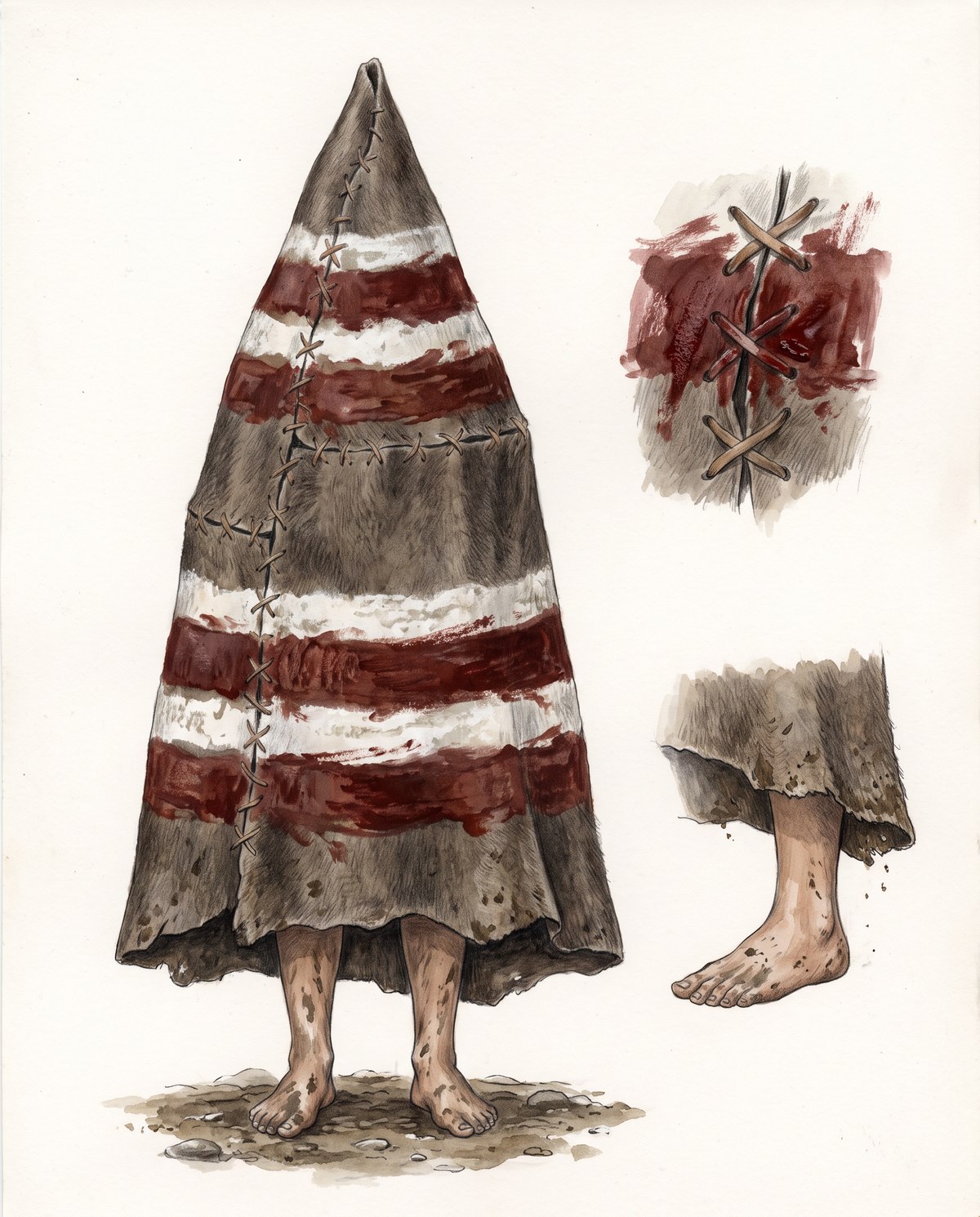
Tanu, hermana de Xalpen. Un armazón de arcos, cueros y juncos la tapaba entera, salvo las pantorrillas. Ilustración de Explora.Tanu, sister of Xalpen. A frame of hoops, hides and rushes covered her entirely, except for her calves. Illustration by Explora.
Luis Garibaldi Honte, un estanciero de ascendencia indígena, se lo explicó a Chapman frente a la cámara. «Siempre dar lo mejor que uno tiene; no dar lo peor que uno tiene, sino lo mejor, dejarse lo peor para sí mismo. Eso nos enseñaban ahí», dijo. Federico Echeuline se acordaba de otra regla, la de esperar en la comida. «Primero los viejos, después él», dijo. Bridges oyó un consejo parecido. Un hombre debía darles carne a los viejos aunque no fueran parientes. Podía ser que, cuando él ya no pudiera cazar, algún joven se la llevara.Luis Garibaldi Honte, an estanciero, or ranch owner, of Indigenous descent, explained it to Chapman on camera. “Always give the best you have; not give the worst you have, but the best, and keep the worst for yourself. That's what they taught us there,” he said. Federico Echeuline remembered another rule, about waiting at meals. “First the old ones, then him,” he said. Bridges heard similar advice. A man should give meat to the old even if they were not his kin. One day, when he could no longer hunt, some young man might bring meat to him.
La muerte y el regreso de los klóketenThe Death and Return of the Klóketen
El momento más fuerte llegaba cuando Xalpen estaba por dar a luz. A las mujeres se les decía que, de tanto estar con los klóketen, había quedado embarazada, y que los dolores del parto la enfurecían. Mataba primero a los klóketen y después a casi todos los hombres, abriéndolos con la larga uña de su dedo índice. La choza se sacudía. Las mujeres reconocían la voz de cada hombre en su último grito. Al final, los pocos que quedaban sacaban de la choza los cuerpos de los klóketen, manchados con sangre de guanaco. Las madres se acercaban lo más que podían, cantando un lamento. Federico Echeuline, que fue klóketen en 1933, se acordaba de esa escena. «Yo estaba de veras apenado al ver llorar a las mujeres de ese modo. Se tomaban en serio la muerte de sus hijos», le dijo a Chapman.The most intense moment came when Xalpen was about to give birth. The women were told that, from spending so much time with the klóketen, she had become pregnant, and that the pains of labor enraged her. She killed first the klóketen and then nearly all the men, slitting them open with the long nail of her index finger. The hut shook. The women recognized each man's voice in his last cry. At the end, the few who were left carried the bodies of the klóketen out of the hut, smeared with guanaco blood. The mothers came as close as they could, singing a lament. Federico Echeuline, who was a klóketen in 1933, remembered that scene. “I was truly sorry to see the women weep like that. They took the death of their sons seriously,” he told Chapman.
Los «muertos» salían a escondidas y pasaban la noche en el bosque. Gusinde contó que después volvían al campamento con mucha caza, llegando desde el lado contrario a la choza. Las mujeres saltaban de alegría. Los había devuelto a la vida Olum, un chamán diminuto que casi nunca se mostraba y que curaba las heridas sin dejar cicatriz. Bridges, que lo llamaba Ohlimink, vio la escena de una de sus curaciones. Lo hizo A-yaah, el más bajo del grupo, porque el único requisito era ser pequeño.The “dead” slipped out in secret and spent the night in the forest. Gusinde related that they later returned to the camp with plenty of game, arriving from the side opposite the hut. The women leaped for joy. They had been brought back to life by Olum, a tiny shaman who was almost never seen and who healed wounds without leaving a scar. Bridges, who called him Ohlimink, saw one of his healing scenes performed. Olum was played by A-yaah, the shortest man in the group, because the only requirement was to be small.
Después Xalpen daba a luz. El recién nacido se llamaba K'terrnen y lo hacía un klóketen delgado, cubierto de plumón pegado a la pintura roja. Salía de la choza con pasos muy cortos, sostenido por el consejero o por un chamán, mientras las mujeres le cantaban de alegría. En 1923 lo sostuvo Tenenesk. Bridges oyó que era hijo de Shoort y escribió que era el único de esos seres amable con las mujeres.Then Xalpen gave birth. The newborn was called K'terrnen and was played by a slender klóketen, covered in down stuck onto red paint. He came out of the hut with very short steps, held up by the counselor or by a shaman, while the women sang to him for joy. In 1923 he was held up by Tenenesk. Bridges heard that he was Shoort's son and wrote that he was the only one of those beings who was kind to women.
Cuando aparecía Halaháches, un espíritu masculino del cielo con cuernos, Xalpen volvía de inmediato bajo la tierra. Las mujeres lo recibían cantando su nombre, pero preparaban bolas de nieve, porque también él mataba hombres. Los sacaba de a dos y los mataba con un garrote, a la vista de todos. Lola se reía al imitarlo. «Halaháches era muy malo», decía.When Halaháches appeared, a horned male spirit from the sky, Xalpen went straight back beneath the earth. The women welcomed him by singing his name, but they got snowballs ready, because he too killed men. He took them out two at a time and killed them with a club, in full view of everyone. Lola laughed as she imitated him. “Halaháches was very bad,” she would say.
El finalThe End
El Hain terminaba de manera sencilla. Gusinde vio que llegaba un cansancio general. Los actores se ponían torpes en sus papeles y a los mayores se les acababan los temas. Los hombres decidían terminar. Shoort hacía su última visita al campamento y el guía anunciaba el final. Las máscaras volvían al tronco hueco. La choza quedaba en pie. En dos o tres días, las familias se dispersaban. Los klóketen salían flacos y agotados, cosa que las mujeres atribuían a Xalpen. Según Bridges, el muchacho podía seguir siendo klóketen dos o tres años más.The Hain ended simply. Gusinde observed that a general weariness set in. The actors grew clumsy in their roles and the elders ran out of things to talk about. The men decided to end it. Shoort made his last visit to the camp and the guide announced the end. The masks went back into the hollow trunk. The hut was left standing. Within two or three days, the families dispersed. The klóketen came out thin and exhausted, which the women attributed to Xalpen. According to Bridges, the boy could remain a klóketen for two or three more years.
El secretoThe Secret
Gusinde estaba seguro de que las mujeres no sabían que los espíritus eran hombres. «Sostengo que ni una sola de las actuales mujeres selk'nam ha descubierto el juego falso de los hombres», escribió. Angela Loij, hija de padre y madre selk'nam, estuvo en el Hain de 1923. «Los espíritus no parecían hombres. No se podía imaginar que lo fueran», le dijo años después a Chapman.Gusinde was sure that the women did not know the spirits were men. “I maintain that not a single one of the present-day Selk'nam women has discovered the men's false game,” he wrote. Angela Loij, whose father and mother were both Selk'nam, was at the Hain of 1923. “They didn't look like men. You could never tell they were,” she told Chapman years later.
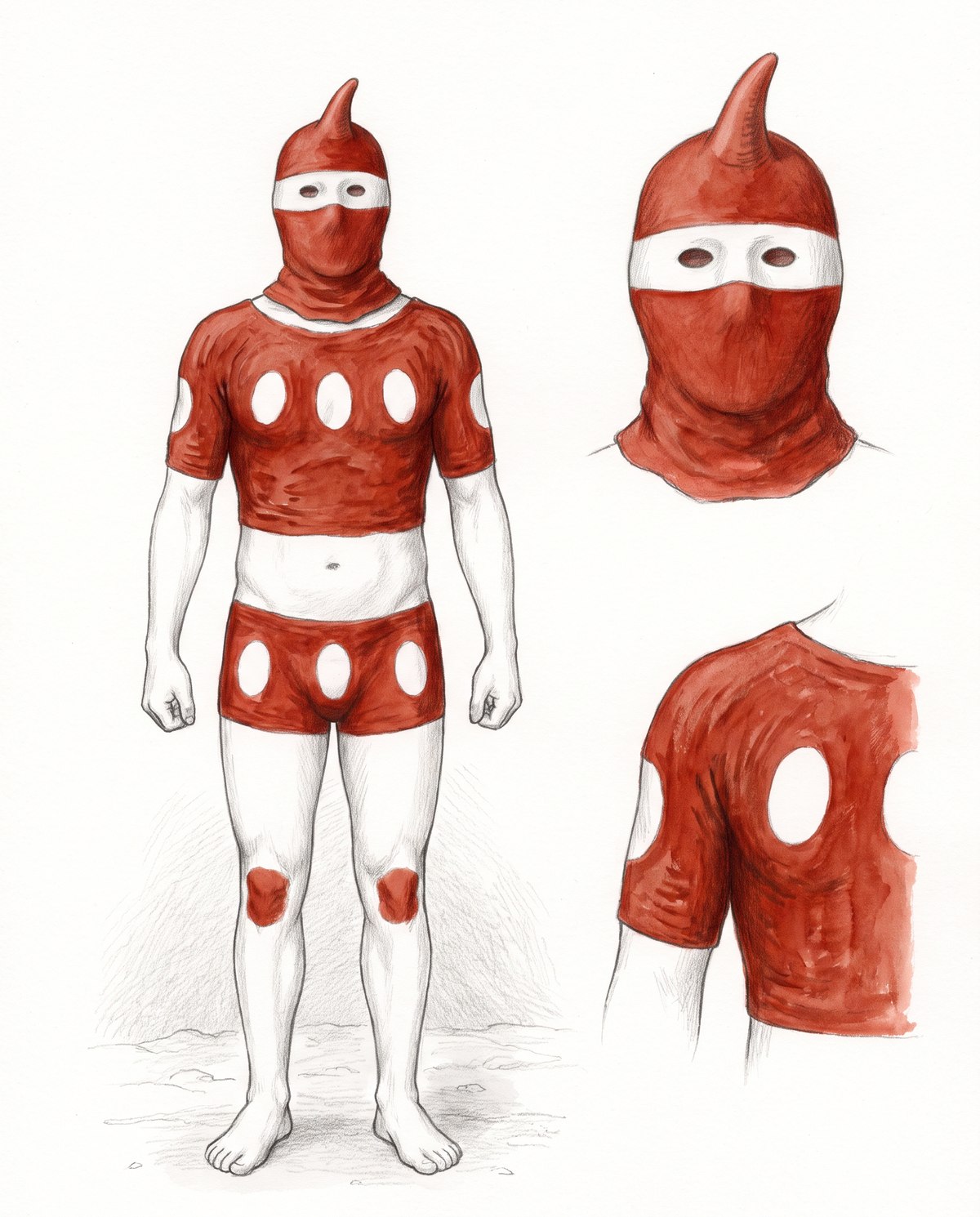
Páhuil, el Shoort del este. Ilustración de Explora.Páhuil, the Shoort of the east. Illustration by Explora.
Bridges lo dudaba. Sospechaba que las mujeres no estaban tan engañadas ni tan asustadas como aparentaban. Pero los klóketen, que habían vivido doce o trece años con sus madres y habrían oído cualquier palabra descuidada, se aterraban la primera vez que veían a Shoort. «Quizás las mujeres sospechaban; si era así, se lo guardaban», escribió. A la que hablara de sus dudas, aunque fuera con otra mujer, la habrían matado. Bridges escribió también que «el avance de la civilización» dejó el secreto al descubierto y que las mujeres llegaron a saber del engaño. Chapman se preguntaba si los hombres creían de verdad haberlo guardado sin que ellas lo supieran. Lola Kiepja le repetía que jamás podría contarle todo sobre el Hain.Bridges had his doubts. He suspected that the women were not as deceived or as frightened as they appeared. But the klóketen, who had lived twelve or thirteen years with their mothers and would have heard any careless word, were terrified the first time they saw Shoort. “Maybe the women suspected; if they did, they kept their suspicions to themselves,” he wrote. Any woman who spoke of her doubts, even to another woman, would have been killed. Bridges also wrote that “the advance of civilization” laid the secret bare and that the women came to know of the hoax. Chapman wondered whether the men truly believed they had kept it without the women knowing. Lola Kiepja kept telling her that she could never tell her everything about the Hain.
Los testigos de 1923The Witnesses of 1923
Casi todo lo que se sabe del Hain viene de 1923. Gusinde entró a la choza como un candidato más, junto a los dos muchachos. Chapman lo consideraba el único europeo que vivió la ceremonia completa. Harambour subraya que la pagó para que se la representaran. Gusinde fotografió a los espíritus. «Hasta los “espíritus” del “klóketen” han quedado impresos en las placas fotográficas», escribió en 1924. Agregó que casi le costó la vida intentar fotografiar a uno mientras se pintaba. Las fotografías de sus cuatro viajes a Tierra del Fuego, más de mil, están en el Anthropos Institut de Sankt Augustin, en Alemania.Almost everything known about the Hain comes from 1923. Gusinde entered the hut as one more candidate, together with the two boys. Chapman considered him the only European to have lived through the entire ceremony. Harambour stresses that he paid for it to be performed for him. Gusinde photographed the spirits. “Even the ‘spirits’ of the ‘klóketen’ have been captured on the photographic plates,” he wrote in 1924. He added that trying to photograph one while it was being painted nearly cost him his life. The photographs from his four journeys to Tierra del Fuego, more than a thousand, are at the Anthropos Institut in Sankt Augustin, Germany.
Angela Loij y Federico Echeuline conocieron a Gusinde ese año. Décadas después fueron, con Lola Kiepja, las principales voces de Chapman. En 1966, junto al Lago Fagnano, Lola le grabó los cantos de la ceremonia, que salieron en un disco en 1977. Cuando los cantaba, imitaba los pasos y los gestos de cada espíritu. Al imitar a Shoort, le daba a Chapman suaves estocadas en las costillas con su bastón. «Shoort era muy mañoso con las mujeres», decía.Angela Loij and Federico Echeuline met Gusinde that year. Decades later, together with Lola Kiepja, they were Chapman's main sources. In 1966, beside Lake Fagnano, Lola recorded the ceremony's chants for her, which came out on a record in 1977. When she sang them, she imitated the steps and gestures of each spirit. When imitating Shoort, she gave Chapman gentle jabs in the ribs with her walking stick. “Shoort was very sly with the women,” she would say.
El fin del HainThe End of the Hain
En 1924 llegó una epidemia de sarampión. «Muertos, muertos, muertos. ¿Cuántos muertos? No sirve el Koliot-xo'on [el médico blanco]. El cementerio está lleno», le contó Lola a Chapman. Entre los muertos estuvo Tenenesk. Según Chapman, la epidemia de 1924 y 1925 diezmó a los casi trescientos selk'nam que quedaban. Desde entonces hubo muy pocos Hain. Federico Echeuline fue klóketen en el de 1933, el último del que se tiene noticia, al que llegaron solo unas pocas familias. En las notas de su primer disco, de 1972, Chapman había dado otro año, 1937.In 1924 a measles epidemic arrived. “Dead, dead, dead. How many dead? The Koliot-xo'on [the white doctor] is no use. The cemetery is full,” Lola told Chapman. Tenenesk was among the dead. According to Chapman, the epidemic of 1924 and 1925 decimated the nearly three hundred Selk'nam who remained. From then on there were very few Hain ceremonies. Federico Echeuline was a klóketen in the 1933 Hain, the last on record, which only a few families attended. In the notes to her first record, from 1972, Chapman had given another year, 1937.
Para entonces la mayoría de los selk'nam había muerto. Desde la década de 1880, las estancias ovejeras ocuparon la isla. Los selk'nam fueron perseguidos, asesinados y deportados. En 2003, una comisión creada por el Estado chileno concluyó que había sido un genocidio.By then most of the Selk'nam had died. From the 1880s on, sheep estancias took over the island. The Selk'nam were persecuted, murdered and deported. In 2003, a commission created by the Chilean State concluded that it had been a genocide.
El Hain hoyThe Hain Today
El 11 de octubre de 2023 se promulgó la Ley 21.606. Con ella, el Estado de Chile sumó a los selk'nam a los pueblos indígenas que reconoce. La ley dice que el Estado «valora su existencia». Según un informe de la Biblioteca del Congreso Nacional de 2020, la ley indígena da a las comunidades, entre otros, el derecho a realizar actividades ceremoniales en tierras fiscales. Desde 2021 viven en Porvenir integrantes de la comunidad selk'nam Covadonga Ona. Trabajan en recuperar la lengua y la memoria.On October 11, 2023, Law 21,606 was enacted. With it, the State of Chile added the Selk'nam to the Indigenous peoples it recognizes. The law states that the State “values their existence.” According to a 2020 report by the Library of the National Congress, the Indigenous Law grants communities, among other things, the right to hold ceremonial activities on public lands. Since 2021, members of the Covadonga Ona Selk'nam community have lived in Porvenir. They work to recover their language and their memory.
Porvenir es el pueblo adonde llega el transbordador que cruza el Estrecho desde Punta Arenas. En febrero de 2016, Harambour fotografió en su entrada norte una figura de acero de unos tres metros. Estaba pintada a franjas blancas y rojas, con una máscara cónica y una placa que dice «Kosmenk / Espíritu Selk'nam». En la entrada sur había otra, un «Ulem» que dice «bienvenidos». Las dos se basaron en las fotografías que Gusinde tomó en 1923. En enero de 2017, Correos Chile presentó seis sellos con esos mismos espíritus.Porvenir is the town where the ferry from Punta Arenas lands after crossing the Strait. In February 2016, at the town's northern entrance, Harambour photographed a steel figure about three meters tall. It was painted in white and red stripes, with a conical mask and a plaque that reads “Kosmenk / Espíritu Selk'nam” (Selk'nam Spirit). At the southern entrance stood another, an “Ulem” that reads “bienvenidos” (welcome). Both were based on the photographs Gusinde took in 1923. In January 2017, Correos Chile issued six stamps featuring those same spirits.
14 fuentes14 sources+
- Bridges, E. L. (1948). Uttermost part of the Earth. Hodder & Stoughton.
- Campos, B. L. A. de. (2025). Entre a transparência e a opacidade: as fotografias do Hain Selk'nam, de Martín Gusinde, como imagens-sintoma. ARS (São Paulo), 23, Artículo e-222069. https://doi.org/10.11606/issn.2178-0447.ars.2025.222069
- Chapman, A. (1972). Selk'nam (Ona) chants of Tierra del Fuego, Argentina: 47 shaman chants and laments [Notas del disco]. Folkways Records.
- Chapman, A. (1977). Selk'nam (Ona) chants of Tierra del Fuego, Argentina, Vol. II: 41 chants of the Hain ceremony [Notas del disco]. Folkways Records.
- Chapman, A. (2002). Fin de un mundo: los selknam de Tierra del Fuego (2.ª ed.). Taller Experimental Cuerpos Pintados. Memoria Chilena. https://www.memoriachilena.gob.cl/archivos2/pdfs/MC0043450.pdf
- Comisión Verdad Histórica y Nuevo Trato con los Pueblos Indígenas. (2008). Informe de la Comisión Verdad Histórica y Nuevo Trato con los Pueblos Indígenas. Comisionado Presidencial para Asuntos Indígenas.
- Explora. (2026). Rutas de exploraciones y puntos de interés de Tierra del Fuego [Conjunto de datos geográficos no publicado, archivos KMZ].
- Gusinde, M. (1924). Cuarta expedición a la Tierra del Fuego: informe del jefe de sección. Publicaciones del Museo de Etnología y Antropología de Chile, 4(1–2), 7–67. Memoria Chilena. https://www.memoriachilena.gob.cl/archivos2/pdfs/MC0018447.pdf
- Gusinde, M. (1982). Los indios de Tierra del Fuego: Tomo primero. Los selk'nam (W. Hoffmann, Trad.; Vol. 2). Centro Argentino de Etnología Americana. (Obra original publicada en 1931)
- Harambour, A. (2018). Los prohombres y los extintos. Patrimonio, identidad e historiografía regional en Magallanes. Cuadernos de Historia, (48), 57–88. https://doi.org/10.4067/S0719-12432018000100057
- Ley 21.606. Incorpora al pueblo selk'nam entre las principales etnias indígenas reconocidas por el Estado. (2023). Diario Oficial de la República de Chile. https://bcn.cl/3l07j
- Meza-Lopehandía, M. y Rivera Polo, F. (2020). Reconocimiento del pueblo selk'nam: antecedentes y análisis de los alcances legales del proyecto de ley [Informe de Asesoría Técnica Parlamentaria]. Biblioteca del Congreso Nacional de Chile.
- Tocornal Montt, M. C. y Muñoz Tapia, A. (2025). Reencontrarse y recordar para volver: las memorias familiares en la reemergencia selk'nam en Chile. Revista Antropologías del Sur, 12(24), 67–91. https://doi.org/10.25074/rantros.v12i24.2788
- Nota. Los nombres de los espíritus siguen a Chapman (2002). Lo que se dice de Kulan, Koshménk, Matan, Tanu, Olum, K'terrnen y Halaháches se toma de ella, que resume a Gusinde (1982). Las citas de Bridges y de las notas de los discos son traducción propia del inglés. Las palabras de Garibaldi Honte y Echeuline se toman del guion de la película de Ana Montes y Anne Chapman, publicado en Chapman (2002). La proporción de uno de cada doce y las ovejas por día son cálculo propio. Las comparaciones con una casa de dos pisos, un auto y el paso de una persona son conocimiento general. El informe de la Comisión Verdad Histórica y Nuevo Trato se entregó en 2003. Se cita su primera edición, de 2008.Note. The names of the spirits follow Chapman (2002). What is said of Kulan, Koshménk, Matan, Tanu, Olum, K'terrnen and Halaháches is taken from her, as she summarizes Gusinde (1982). Bridges is quoted in his original English, as are Lola Kiepja's “Halaháches was very bad” and Angela Loij's words on the spirits, both from the 1977 record notes. The other quotations, from Gusinde, Chapman (2002), Tenenesk, Lola Kiepja, the Hain chants and the law, are our translation from the Spanish. The words of Garibaldi Honte and Echeuline are taken from the script of the film by Ana Montes and Anne Chapman, published in Chapman (2002), in our translation. The proportion of one in twelve and the sheep per day are our own calculation. The comparisons with a two-story house, a car and a person's walking pace are general knowledge. The report of the Comisión Verdad Histórica y Nuevo Trato was delivered in 2003. Its first edition, from 2008, is cited.
Seguir por los pueblos de la islaMore on the peoples of the island
Cultura y antropología · 8 minCulture and anthropology · 8 min
Martin Gusinde en Tierra del FuegoMartin Gusinde in Tierra del Fuego
En julio de 1923, cruzando la montaña en pleno invierno, el etnólogo Martin Gusinde perdió el conocimiento en un viento que no dejaba tenerse en pie. …In July 1923, crossing the mountains in the dead of winter, ethnologist Martin Gusinde lost consciousness in a wind so strong that no one could stay o…
Cultura y antropología · 6 minCulture and anthropology · 6 min
Lola Kiepja y los cantos selk'nam del Lago FagnanoLola Kiepja and the Selk'nam Chants of Lake Fagnano
«¡Encontré otro!», le decía algunas mañanas Lola Kiepja a la antropóloga Anne Chapman, esperándola en la puerta de su choza. Durante la noche había re…“I found another,” Lola Kiepja would sometimes call out in the morning as she waited at the door of her hut for the anthropologist Anne Chapman. Durin…