
HistoriaHistory
Los aserraderos del Seno AlmirantazgoThe Sawmills of Admiralty Sound
La lenga del aserradero de Caleta María se cortaba junto al Lago Fagnano, bajaba flotando por el río Azopardo y salía en goleta hacia Punta Arenas. El contador de la firma que lo mantuvo quince años lo resumió en tres palabras: «era de quijotes».The lenga for the Caleta María sawmill was cut beside Lake Fagnano, floated down the Azopardo River, and shipped by schooner to Punta Arenas. The accountant for the firm that ran it for fifteen years summed it up in three words: “it was quixotic.”
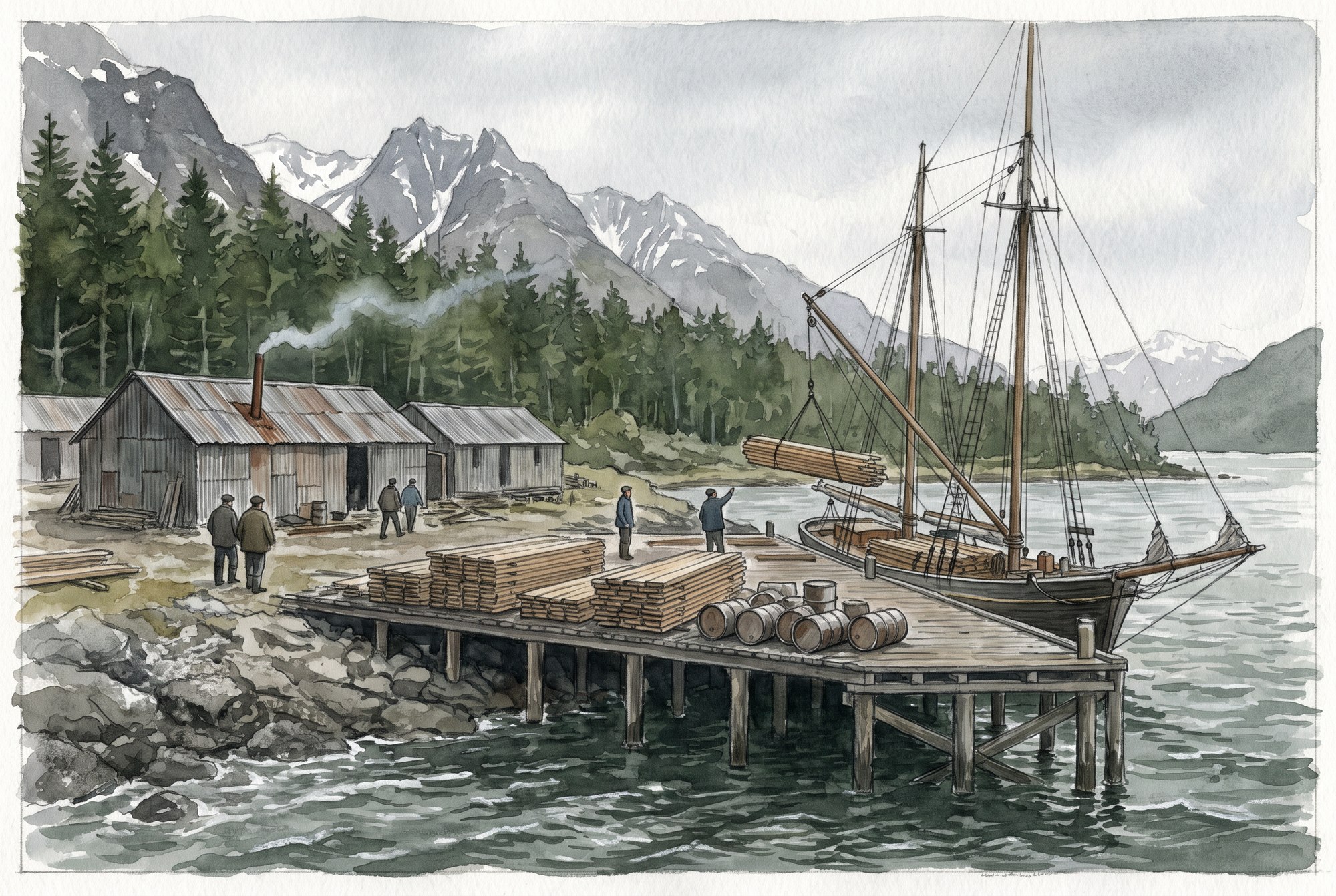
El aserradero de Caleta María en actividad: el muelle, la madera apilada y la goleta que la llevaba a Punta Arenas. Ilustración de Explora.The Caleta María sawmill at work: the pier, the stacked timber and the schooner that carried it to Punta Arenas. Illustration by Explora.
Juan Kuzmanic entró a los diecisiete años como junior a la firma Campos Menéndez, en Punta Arenas, y fue su contador entre 1944 y 1969. Parte de su trabajo era viajar al aserradero de Caleta María, en el fondo del Seno Almirantazgo, a contar la madera aserrada, que se medía en pies madereros, hacer inventarios y pagar los sueldos. Iba en la Gloria, la goleta que la firma había comprado para llevar esa madera a Punta Arenas. Esos viajes se le hacían muy largos. En el camino era obligatorio parar en la isla Dawson a tomar desayuno con el administrador de la isla, Kenneth Morrison, un desayuno que siempre terminaba con un buen vaso de whisky.Juan Kuzmanic joined the Campos Menéndez firm in Punta Arenas as a junior clerk at seventeen and was its accountant from 1944 to 1969. Part of his job was to travel to the Caleta María sawmill, at the head of Admiralty Sound, to tally the sawn lumber, which was measured in board feet, take inventory, and pay wages. He traveled on the Gloria, the schooner the firm had bought to carry that lumber to Punta Arenas. Those trips felt very long to him. On the way, a stop at Dawson Island was obligatory, for breakfast with the island's manager, Kenneth Morrison, a breakfast that always ended with a good glass of whisky.
Caleta María fue el último de los aserraderos del Seno Almirantazgo, el fiordo que entra desde el Estrecho de Magallanes hacia el sureste, al pie de la Cordillera Darwin. El primero había sido Puerto Yartou, en el canal Whiteside, cuya apertura se fecha en 1908 o a mediados de la década de 1910. Como los demás de esa costa, tenía su propio muelle, porque solo se llegaba en barco y la madera también salía embarcada. Durante años, los aserraderos del Almirantazgo fueron los mayores exportadores de madera hacia el sur argentino. La madera de La Paciencia, otro aserradero de esa costa, llegaba hasta Buenos Aires, Montevideo y las islas Malvinas. En 1930, Argentina puso fuertes derechos de aduana a la madera chilena. Esos aserraderos perdieron a sus mejores compradores.Caleta María was the last of the sawmills of Admiralty Sound, the fjord that runs southeast from the Strait of Magellan to the foot of the Darwin Range. The first had been Puerto Yartou, on the Whiteside Channel, whose opening is dated to 1908 or to the mid-1910s. Like the others on that coast, it had its own pier, because the only way in was by boat, and the lumber also left by sea. For years, the Admiralty Sound sawmills were the largest exporters of timber to southern Argentina. Timber from La Paciencia, another sawmill on that coast, reached as far as Buenos Aires, Montevideo, and the Falkland Islands (Malvinas). In 1930, Argentina imposed heavy customs duties on Chilean timber. Those sawmills lost their best buyers.
El de Caleta María se fundó doce años después, en 1942, donde se juntan los valles del Azopardo y del río Fontaine. Fue idea de Alejo Marcou, socio de la firma en ese negocio, que en palabras de Kuzmanic «siempre tenía ideas pero no tenía capital». Insistió hasta convencer a los Campos Menéndez de que era un buen negocio. La lenga se cortaba sobre todo junto al Lago Fagnano y bajaba por el río Azopardo hasta el aserradero. En 1950 vivían en la caleta unas cincuenta personas, todas ligadas al aserradero, que tenía muelle, galpones y casas.The Caleta María sawmill was founded twelve years later, in 1942, where the valleys of the Azopardo and the Fontaine River meet. It was the idea of Alejo Marcou, the firm's partner in that business, who in Kuzmanic's words “always had ideas but no capital.” He kept at it until he convinced the Campos Menéndez family that it was a good business. The lenga, a southern beech, was cut mainly beside Lake Fagnano and came down the Azopardo River to the sawmill. In 1950 some fifty people lived in the cove, all of them tied to the sawmill, which had a pier, sheds, and houses.
«¡Qué noche más helada, larga y preocupante!»“What a cold, long, and worrying night!”
En uno de sus viajes, a Kuzmanic lo acompañó Jorge Campos Menéndez. Al día siguiente de llegar salieron a caballo hacia el Lago Fagnano y cruzaron el río Azopardo con los caballos a nado. Con ellos iba el administrador del aserradero, Raúl Arcos, que les dijo que soltaran las riendas, porque los caballos buscarían solos el camino entre las turberas. «Uno pensaba, con cierto temor, si esos nobles animales no se equivocarían por casualidad», recordaba Kuzmanic. Todo el trayecto hasta el lago fue en subida. En la orilla vivía Pedro Martinic, que cuidaba los vacunos de la firma y los invitó a almorzar en su puesto. Después fueron a ver dónde se cortaban las vigas y salieron en la lancha Susana, hasta que se dieron cuenta de que hacía agua. Volvieron al puesto sacando el agua con un balde.On one of his trips, Jorge Campos Menéndez went along with Kuzmanic. The day after they arrived, they rode out toward Lake Fagnano and swam the horses across the Azopardo River. With them was the sawmill's manager, Raúl Arcos, who told them to let go of the reins, because the horses would find their own way among the peat bogs. “One wondered, somewhat fearfully, whether those noble animals might not happen to lose their way,” Kuzmanic recalled. The whole way to the lake was uphill. On the shore lived Pedro Martinic, who looked after the firm's cattle and invited them to lunch at his outpost. Afterward they went to see where the beams were cut and went out in the launch Susana, until they realized it was taking on water. They made it back to the outpost bailing with a bucket.
En junio de 1955, la que hizo agua fue la Gloria. Era un día muy helado. Frente al aserradero, el mar estaba escarchado hasta más de trescientos metros de la orilla, la altura de la torre Eiffel, pero no había viento y el agua estaba en calma. Hacia las tres de la tarde zarpó la Gloria, cargada de madera y de tambores de petróleo vacíos, con veintitrés personas a bordo, entre ellas dos mujeres, el contratista Alfredo Agoni y su personal, y Reinaldo Catalán. Kuzmanic iba en el puente con el capitán, Antonio Délano, cuando el maquinista, Heriberto Yáñez, subió corriendo a decir que estaba entrando agua a la sala de máquinas. Cuando bajaron, el agua llegaba casi a la mitad del motor. Délano ordenó ponerse los salvavidas y bajar los botes y una chata que se usaba para acarrear leña.In June 1955, it was the Gloria that took on water. It was a bitterly cold day. In front of the sawmill, the sea was covered in frost for more than three hundred meters out from the shore, a distance equal to the height of the Eiffel Tower, but there was no wind and the water was calm. At about three in the afternoon the Gloria set sail, loaded with timber and empty oil drums, with twenty-three people aboard, among them two women, the contractor Alfredo Agoni and his crew, and Reinaldo Catalán. Kuzmanic was on the bridge with the captain, Antonio Délano, when the engineer, Heriberto Yáñez, ran up to say that water was coming into the engine room. When they went down, the water reached almost halfway up the engine. Délano ordered everyone to put on life jackets and to lower the boats and a barge used for hauling firewood.
Kuzmanic fue el primero en subirse a un bote. «Gritaba las mujeres y los niños primero, claro, eso es lo que se dice como frase de costumbre, pero cuando uno ve que su vida es la que corre peligro, la frase que te viene a la cabeza es "sálvese quien pueda" no más», escribió años después en sus memorias. Un muchacho, aterrado por lo rápido que subía el agua, se tiró de cabeza al mar. Sus compañeros lo sacaron antes de que se congelara. Ya de noche, los marinos remaron hasta la isla Tres Mogotes, cubierta de nieve y escarcha. Encendieron fuego con unas peinetas de carey de una de las mujeres y pasaron la noche dando vueltas alrededor de la fogata. «¡Qué noche más helada, larga y preocupante!», anotó Kuzmanic.Kuzmanic was the first to get into a boat. “I was shouting ‘women and children first,’ of course, that's what one says out of habit, but when you see that it's your own life in danger, the phrase that comes to mind is just ‘every man for himself,’” he wrote years later in his memoirs. A boy, terrified by how fast the water was rising, dove headfirst into the sea. His companions pulled him out before he froze. After dark, the sailors rowed to Tres Mogotes Island, covered in snow and frost. They lit a fire with some tortoiseshell combs belonging to one of the women and spent the night walking in circles around the fire. “What a cold, long, and worrying night!” Kuzmanic wrote.
Al amanecer vieron que la goleta seguía ahí. No se había hundido, pero el agua le llegaba a la mitad del puente de mando. La remolcaron hasta la playa del fondo del seno y la subieron a la arena con un cabrestante, un torno que enrolla el cable para tirar de ella, mientras le salía agua por todos lados. Al zarpar, la proa había chocado con el hielo de la bahía. Kuzmanic lo atribuyó al agua del Azopardo, que en esa orilla hace al mar menos salado. Un agujero de unos veinticinco centímetros de largo y cinco de ancho bastó para que en un par de horas la goleta quedara inundada.At dawn they saw that the schooner was still there. It had not sunk, but the water reached halfway up the bridge. They towed it to the beach at the head of the sound and pulled it up onto the sand with a capstan, a winch that winds in a cable to drag a load, while water streamed out of it on all sides. As it left the cove, its bow had struck the ice in the bay. Kuzmanic put it down to the water of the Azopardo, which makes the sea less salty along that shore. A hole about twenty-five centimeters long and five wide was enough to flood the schooner in a couple of hours.
Arreglarla tomó veintiún días. Mientras tanto, Kuzmanic ordenó que el capitán hablara dos veces al día por la radio del aserradero con la Gobernación Marítima, la autoridad de la Armada que controla la navegación, para decir siempre lo mismo: «Goleta Gloria, fondeada en Caleta María y sin novedad». En Punta Arenas nadie se inquietó hasta que empezaron las llamadas desde Santiago y Buenos Aires preguntando por Kuzmanic, cada vez con más insistencia. Taparon el agujero con un pedazo de tabla y brea, y zarparon «no del todo tranquilos». Llegaron a Punta Arenas sin problemas. El percance quedó en secreto, porque si se sabía, la firma se exponía a sanciones por no haber tomado medidas de seguridad antes de zarpar. Los Campos Menéndez gratificaron a los tripulantes por guardar silencio. Años después, el casco quedó abandonado en Bahía Buena. Kuzmanic conservó la placa con el nombre de la goleta.The repairs took twenty-one days. Meanwhile, Kuzmanic ordered the captain to speak twice a day over the sawmill's radio with the Gobernación Marítima, the Navy authority that controls shipping, and to say the same thing every time: “Schooner Gloria, anchored at Caleta María, nothing to report.” In Punta Arenas no one grew uneasy until calls began coming from Santiago and Buenos Aires asking after Kuzmanic, more and more insistently. They plugged the hole with a piece of board and pitch and set sail “not entirely at ease.” They reached Punta Arenas without trouble. The mishap was kept secret, because if word got out, the firm risked penalties for not having taken safety measures before sailing. The Campos Menéndez family rewarded the crew for keeping quiet. Years later, the hull was left abandoned at Buena Bay. Kuzmanic kept the schooner's nameplate.
Catalán, que trabajó en el aserradero a mediados de los años cincuenta, se preguntaba «¿para qué tener un aserradero tan lejos, tanto sacrificio, tanto gasto, si en Punta Arenas habían aserraderos más cerca y que vendían la madera más barata?». Para la firma, el aserradero terminó en 1957, cuando Agoni concluyó su trabajo como contratista. Ese mismo año murió Marcou. «En caleta María la madera no era negocio, no era rentable, no era comercial, era muy difícil explotar los bosques allí, después había que traer la madera hasta Punta Arenas, era de quijotes», lo resumió Kuzmanic.Catalán, who worked at the sawmill in the mid-1950s, wondered “why have a sawmill so far away, so much sacrifice, so much expense, if there were sawmills closer by, in Punta Arenas, that sold timber cheaper?” For the firm, the sawmill came to an end in 1957, when Agoni finished his work as contractor. That same year Marcou died. “At Caleta María timber was not a business, it was not profitable, it was not commercial, it was very hard to work the forests there, then the timber had to be brought to Punta Arenas, it was quixotic,” Kuzmanic summed up.
Más de medio siglo después, cuando le contaron que había un camino hasta Caleta María, Kuzmanic dijo que en sus tiempos al que hablara de eso lo habrían tildado de loco, porque «si por mar era difícil llegar, por tierra era imposible». Hoy ese camino existe y une el Lago Fagnano con Caleta María. Parte junto a la salida del río Azopardo, cerca de donde se cortaba la lenga, y termina en la orilla desde la que se navega hacia los fiordos de la Cordillera Darwin.More than half a century later, when he was told there was a road to Caleta María, Kuzmanic said that in his day anyone who talked of such a thing would have been called crazy, because “if it was hard to get there by sea, by land it was impossible.” Today that road exists and links Lake Fagnano with Caleta María. It starts beside the outlet of the Azopardo River, near where the lenga was cut, and ends on the shore where boats set out for the fjords of the Darwin Range.
6 fuentes6 sources+
- Explora. (2026). Rutas de exploraciones y puntos de interés de Tierra del Fuego [Conjunto de datos geográficos no publicado, archivos KMZ].
- Fernández, M. (2014). Rastreando huellas: la dinámica del paisaje en La Paciencia, Tierra del Fuego. Magallania, 42(1), 35–52. https://doi.org/10.4067/S0718-22442014000100003
- García Oteiza, S. (2013). Vestigios patrimoniales del aserradero Caleta María, Tierra del Fuego (Chile). Magallania, 41(1), 53–82. https://doi.org/10.4067/S0718-22442013000100003
- García Oteiza, S. (2016). Puerto Yartou, Tierra del Fuego (1929). Magallania, 44(2), 233–240. https://doi.org/10.4067/S0718-22442016000200014
- Martinic, M. (1982). La Tierra de los Fuegos: historia, geografía, sociedad, economía. Municipalidad de Porvenir.
- Nota. Los testimonios y las memorias de Juan Kuzmanic y Reinaldo Catalán, el naufragio de la Gloria (2 de junio de 1955) y la noticia de El Magallanes (19 de febrero de 1930) sobre los derechos de aduana argentinos se citan según García Oteiza (2013). La fecha de 1908 para Puerto Yartou es de García Oteiza (2016), y la de mediados de la década de 1910, de Martinic (1982). La llegada por mar a los aserraderos del Almirantazgo proviene también del conocimiento de terreno de Explora (comunicación personal, 2026). La descripción del Seno Almirantazgo, la función de la Gobernación Marítima y la altura de la torre Eiffel (unos 300 m sin antenas) son conocimiento general. El trazado del camino entre el Lago Fagnano y Caleta María es medición propia sobre las rutas de Explora.Note. The testimonies and memoirs of Juan Kuzmanic and Reinaldo Catalán, the wreck of the Gloria (June 2, 1955), and the report in El Magallanes (February 19, 1930) on the Argentine customs duties are cited from García Oteiza (2013); the quotations are our translation from the Spanish. The 1908 date for Puerto Yartou is from García Oteiza (2016), and the mid-1910s date from Martinic (1982). That the Admiralty Sound sawmills were reached by sea also comes from Explora field knowledge (personal communication, 2026). The description of Admiralty Sound, the role of the Gobernación Marítima, and the height of the Eiffel Tower (about 300 m without antennas) are general knowledge. The route of the road between Lake Fagnano and Caleta María is our own measurement on Explora's routes.
Seguir por estancias, oficios y parquesMore on estancias, trades and parks
Historia · 5 minHistory · 5 min
La vida en la estancia Cameron de Bahía InútilLife on the Cameron Estancia on Useless Bay
Dos ovejeros escoceses vivieron dos meses en un puesto de la estancia Cameron sin dirigirse la palabra. Cuando el menor por fin dijo «¡buenos días!», …Two Scottish shepherds lived for two months at an outpost of the Cameron estancia without exchanging a word. When the younger one finally said “Good m…
Geología y geomorfología · 4 minGeology and landforms · 4 min
El terremoto de 1949 en Caleta María y el río AzopardoThe 1949 Earthquake at Caleta María and the Azopardo River
A las tres de la madrugada del 17 de diciembre de 1949, la tierra se abrió en Caleta María. Mientras seguía temblando cada minuto, el administrador de…At three in the morning on December 17, 1949, the ground split open at Caleta María. With the earth still shaking every minute, the sawmill manager ra…